How to become a nurse in the U.S.: pick a license, then a board
Becoming a nurse in the United States is four doors people mash together: a nurse-aide registry, an LPN or LVN license, an associate RN, and a bachelor RN. Night one is which license you are buying, in which state, from a program that board will recognize. An Indianapolis garage with a warm CNA badge and two flyers — “LPN in twelve months” versus “evening ADN” — is that decision, not a TED Talk.
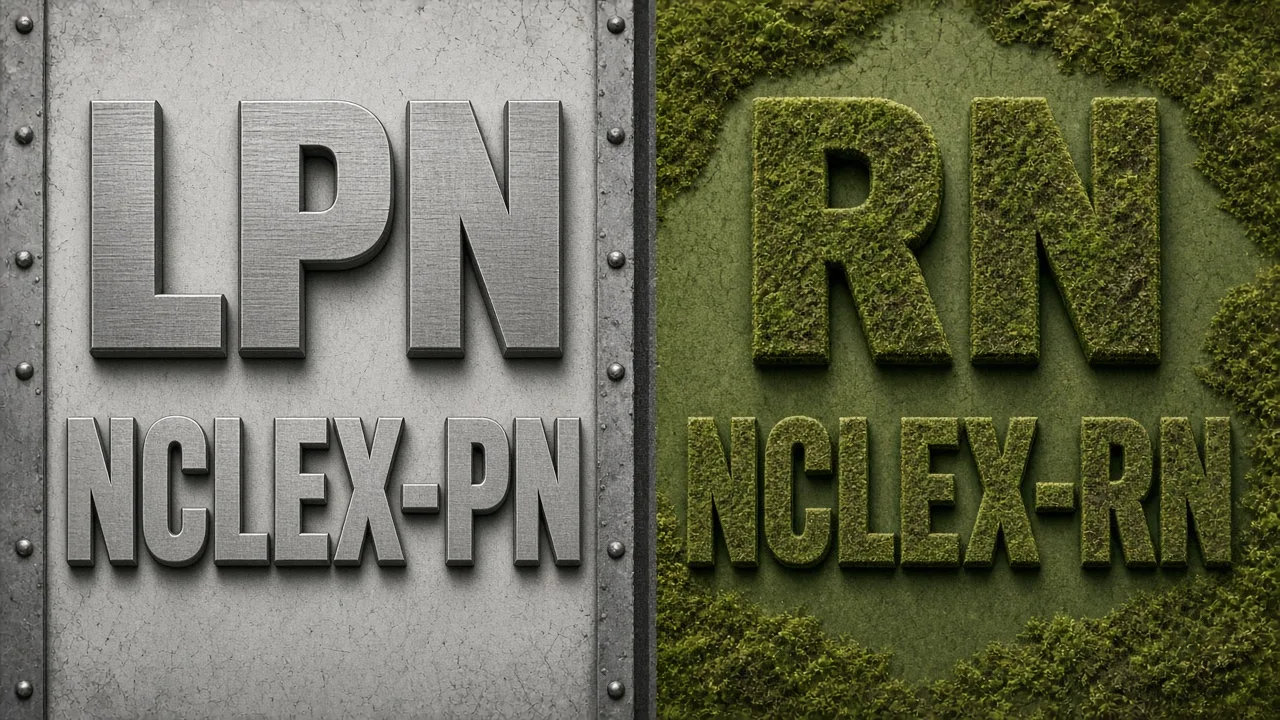
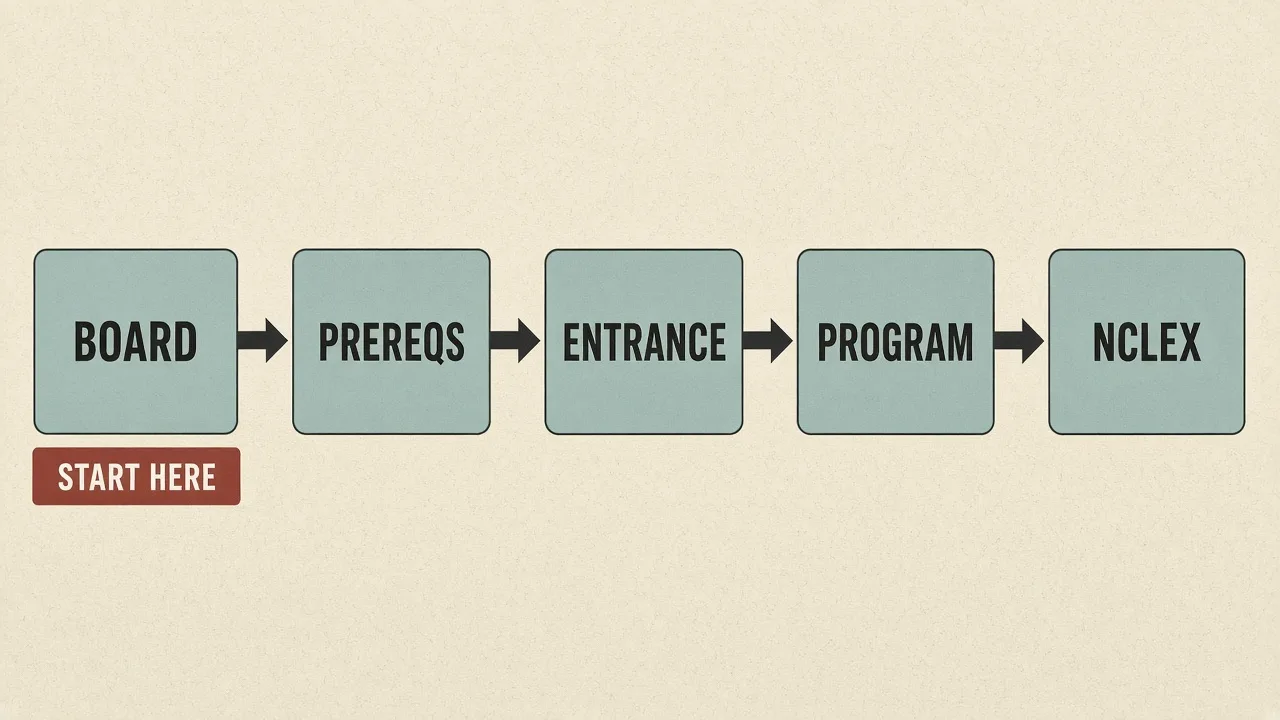
This guide names the door, opens the board first, then the school, then the entrance exam the catalog printed, then NCLEX last. Compare LPN and RN on two licenses. Time by door lives on how long school takes. Compact travel comes after a home-state license: the 60-day rule.
This guide is written for the garage, not the brochure. Nursier does not admit students, approve programs, or issue licenses. We write so you can name the door, open your board’s page, and then study the exam that sits in front of that door: an entrance test now, or NCLEX-RN or NCLEX-PN when a faculty member has already signed your name.

Four doors people mix up
The Bureau of Labor Statistics is useful here because it refuses to romanticize the job. BLS says registered nurses take one of three education paths: a bachelor’s degree in nursing, an associate’s degree in nursing, or a diploma from an approved program, and then they must be licensed. BLS says licensed practical and licensed vocational nurses complete an approved program that is often about one year, and then they must be licensed too. Those are two licenses. They are not a personality test.
| Door | What you can legally do after you finish | The exam at the end | Who it often fits |
|---|---|---|---|
| Nurse aide or assistant | A state nurse aide registry, not an LPN or RN license | A competency exam your state names, not NCLEX | A person who needs a paycheck and a look at the work before a multi-year program |
| LPN or LVN | A practical or vocational nurse license, with a defined scope | NCLEX-PN | A person who wants a license sooner and may bridge to RN later |
| RN, associate | An RN license after an approved associate program | NCLEX-RN | A person who wants the RN license without a four-year calendar |
| RN, bachelor | An RN license after an approved BSN, plus a degree many employers prefer | NCLEX-RN, same exam as the associate graduate | A person who can carry the extra general-education load, or who already holds a degree |
BLS also prints a “typical entry-level education” line for RNs that says bachelor’s degree. That line is a labor-market summary. It is not a board rule. Plenty of RNs still enter through an associate program. Plenty of hospitals still hire them. Plenty of those same hospitals later ask for a BSN on a timeline. Those are three different sentences. Keep them apart.
A second-degree or accelerated BSN is not a fifth license. It is the bachelor door taken by a person who already holds a degree in something else. The license at the end is still RN. The calendar is shorter because the chemistry is already done, not because the board invented a shortcut.
If you already hold an RN license and you are shopping an online completion degree, you are not “becoming a nurse.” You are buying a credential. That is a different article. Start with what accreditation and clinicals actually decide.
Board first, school second
Your nursing regulatory body is the office that will print the license. Schools market. Boards decide. NCSBN’s public page on program approval is the national map for that idea. Faculty sign that you are safe enough to test. The board decides whether that signature counts in that state.

A twenty-minute board visit
- Search the board for the state where you will live when you apply, not the state where a cousin liked a school.
- Open the education or program-approval page. Find the list or database of approved prelicensure programs.
- Open the licensure page for RN or PN, whichever door you picked. Write the application fee as “board money,” not as NCLEX money.
- Search “out of state” and “distance” if any program you like sits across a line.
- Save the PDFs. Do not trust a screenshot in a group chat.
If the school is not on that list, stop. A recruiter who says “we are national” is not a substitute for a row on a board page. If you are still comparing online options, the five checks in the accreditation guide belong here, not later.
NCSBN also keeps a Nurse Licensure Guidance tool and a nursing regulation hub. Use those to find your board. Then leave NCSBN and read the board itself. A national page cannot quote your fingerprint vendor.
Prerequisites without a fake national list
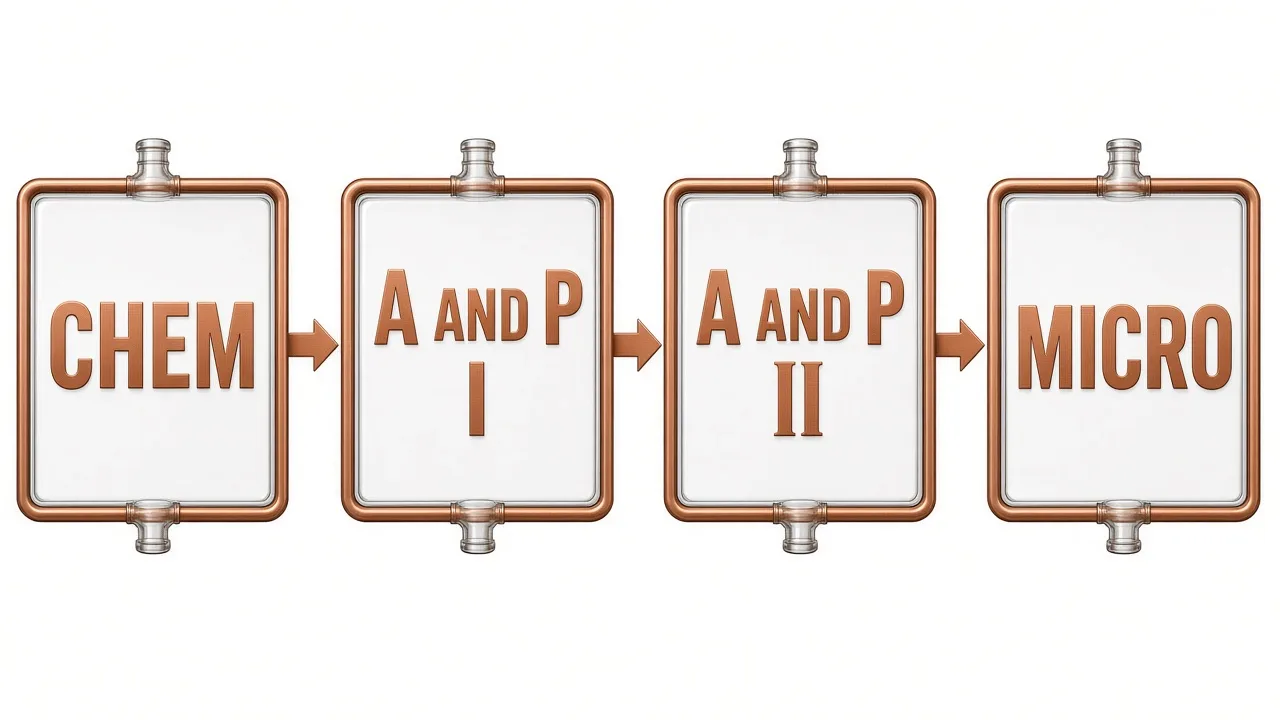
There is no single American prerequisite list. Community colleges and universities publish their own. The pattern is familiar: anatomy and physiology with a lab, microbiology, a chemistry, English, a math that satisfies the program, and sometimes a lifespan psychology. The grade floor is local. A “C is fine” rumor from 2019 is not a 2026 catalog.
Take the science at a school the program already accepts. A cheap online anatomy that your ADN will not transfer is not cheap. Ask for the transfer table in writing before you pay the second course.
If you are still assembling those courses, you are not late to nursing. You are in the part that decides whether the later years are survivable. Study the science as if a patient will ask you to explain it, because one will. Extra practice that matches a book chapter belongs with nursing book questions. That is not an entrance exam, and it is not NCLEX.
The entrance exam your catalog named
Schools pick the front door. Many want ATI TEAS 7. Many want HESI A2. Some want another test. Those exams are not interchangeable, and neither one is the license exam. TEAS 7 reports four sections: reading, math, science, and English. HESI A2 is a packet. The school chooses the sections and the cut score.
Write four facts on a card: the exam name, the required sections, the minimum scores, and the last date a score is accepted. Then sit a short diagnostic in that exam only. Prepare for TEAS 7 or HESI A2, whichever the catalog named. They are not interchangeable.
Nursier does not sell TEAS or HESI. We do not register you with ATI or Elsevier. Practice here is unofficial. When you pay for the real seat, you pay the company that owns that exam.

What the program years actually feel like
We will not invent a national “nursing school takes X months” number. Calendars move with the door you picked, with whether you already hold a degree, and with whether you work 36 hours. BLS can say “often about one year” for many practical programs. Your PDF can say 16 months of evenings. Both can be true for different people.
What does not move is the shape of the work:
- Lecture. Pathophysiology at a table. Tests that punish guessing.
- Skills lab. You will stick a classmate, and a classmate will stick you. You will drop a sterile field and start over.
- Clinical. A unit that does not care about your midterm. A preceptor who will ask what you hear in that chest.
- The quiet costs. Gas, a second background check, a lost shift, a babysitter on a 6 a.m. clinical.
Pack for those days after the program says yes, not before. The supply list is a later document. When you get there, what you actually need for nursing school is the short list, not a haul.
If you are already inside a program, keep the exam in front of you in its own lane. Course products such as ATI or HESI during the program are not NCLEX, even when a classmate calls them that. Unofficial RN practice belongs with an RN track. Unofficial LPN practice belongs with a practical or vocational license.
Money without a made-up salary promise
BLS published a 2025 median RN wage of $97,550 and a faster-than-average outlook through 2035. That median includes people who have been on a unit for twenty years, people in high-cost cities, and people in specialties you will not touch in year one. It is not a signing bonus. Read the footnote. Then open the BLS pay tab for registered nurses and the matching LPN pay tab for the percentile story, not for a promise.
Tuition is local. Use College Scorecard and the school’s net-price calculator. Add board fees, a fingerprint vendor, and the Pearson registration that belongs to NCLEX, which we already walked in NCLEX cost in 2026 and the 2027 increase. Nursier does not collect those fees.
A person who needs the Tuesday night shift should ask the program for the median finish time among students who work 32 hours or more. If they cannot say, believe the silence.
Graduation, the board, and NCLEX
NCLEX is not how you become a nurse in week one. It is how a board tests whether a graduate of an approved program is safe enough for entry-level practice. You apply to the board. The board makes you eligible. You register with Pearson VUE. You wait for Authorization to Test. You sit the exam that matches the license: RN or PN. Those seats are not interchangeable.
Confirm the current registration table on NCLEX fees and payment. Confirm the candidate rules in the bulletin your exam year names. Then study judgment, not a second fee spreadsheet. When you are close, open NCLEX-RN or NCLEX-PN and sit a short set. Nursier practice is unofficial. It will not replace a clinical morning.
The first job and the compact
The first job is usually a unit that will train you, not a specialty that photographed well. New-graduate residencies exist. They are competitive. A long-term care floor, a med-surg unit, and a night-shift clinic have all launched real careers. Do not spend the last semester shopping travel-nurse ads. You need a home license and a year of ordinary practice before that market wants you.
The Nurse Licensure Compact is a later tool. It can let a nurse who lives in a compact jurisdiction and holds a multistate license practice in other compact jurisdictions without a second single-state license. It does not replace the first license. It does not fix an unapproved program. It has a residence rule. Nurses who move must follow the compact’s timeline for a new primary state of residence. Read that on the live sites, not on a Facebook map from 2022:
If your home state is not in the compact, you still become a nurse. You apply in that state. You add other states later, one board at a time, if you need them.
If you already work in health care
A CNA, an EMT, a medic, a medical assistant, and an LPN each enter the garage with different credit and different fatigue. None of those jobs automatically shortens an RN program. Some programs award a handful of credits. Some forbid using your home unit for clinicals. Ask. A yes on the phone that becomes a no in week six is how people lose a semester.
If you are an LPN who wants RN, you are changing licenses, not collecting a badge sticker. Keep PN exams and RN exams apart. If ATI LPN or HESI LPN is the test in front of you now, study that one. Switch to RN-level practice when the bridge is real.
Internationally educated nurses have extra credential steps. Those steps belong to the board and, in many cases, to a credential evaluator the board names. We will not invent that fee. The cost article names the extra chairs without quoting a number we cannot see.
After you pick the door
Write the door on a card. Write the board. Write the exam the school named. Then stop collecting flyers. Collecting flyers feels like progress. It is not a clinical hour and it is not a science credit.
If the next task is an entrance score, sit that exam. If the next task is a prerequisite, finish the lab. If the next task is a license exam, study that exam. Sit practice questions when you are ready to do work that is not shopping. The Nursier editorial team wrote this.
We do not take program deposits. We do not take board fees. We do not take NCLEX fees. Your board and Pearson keep those payments.
Common questions
Do I have to be a CNA first?
No. Some programs like the experience. Some require a nurse aide course. Many do not. A CNA job can tell you whether you can stand the work. It is not a secret first semester.
Is LPN a waste if I want to be an RN?
It is a license with a paycheck and a scope. It is a waste only if you were sold it as a faster RN. If you need income and a look at the work, it can be the honest door. If you can carry an ADN or BSN now, take the RN door and skip the double tuition.
Does a BSN make me more of a nurse than an ADN?
The license exam is the same NCLEX-RN. The degree is different. Some employers pay for the BSN later. Some want it on a deadline. That is a job market, not a moral ranking.
Can I become a nurse fully online?
You can move a lot of lecture online. You cannot skip supervised direct care for a first license. If a page says otherwise, ask the board, not the ad.
How long does it take?
Your catalog wins. Practical programs are often near a year. Associate programs are often near two academic years after prerequisites. Bachelor programs are often near four, or less if you already hold a degree. Working nights changes every one of those sentences.
When do I start NCLEX prep?
When the program is actually ending, or when faculty tell you the cohort is in the NCLEX window. Studying NCLEX in week three of fundamentals is how people ignore the exam they have this week. Do not mix the two.
Sources
Confirm live pages. Boards move tables.
- BLS Occupational Outlook, registered nurses
- BLS Occupational Outlook, licensed practical and licensed vocational nurses
- NCSBN, approval of nursing education programs
- NCSBN, nursing regulation
- NCSBN, Nurse Licensure Guidance
- NCSBN, find your Nurse Practice Act
- NCSBN, Nurse Licensure Compact
- NurseCompact.com
- NCLEX fees and payment
- NCSBN exams
- AACN, resources for students
- College Scorecard
Nursier is independent. We are not affiliated with, endorsed by, or sponsored by NCSBN, Pearson VUE, ATI, Elsevier, BLS, or any state board. This article is planning copy. It is not an application, and it is not legal advice. Wage figures belong to BLS and are not a job offer.