What you actually need for nursing school, bag by bag
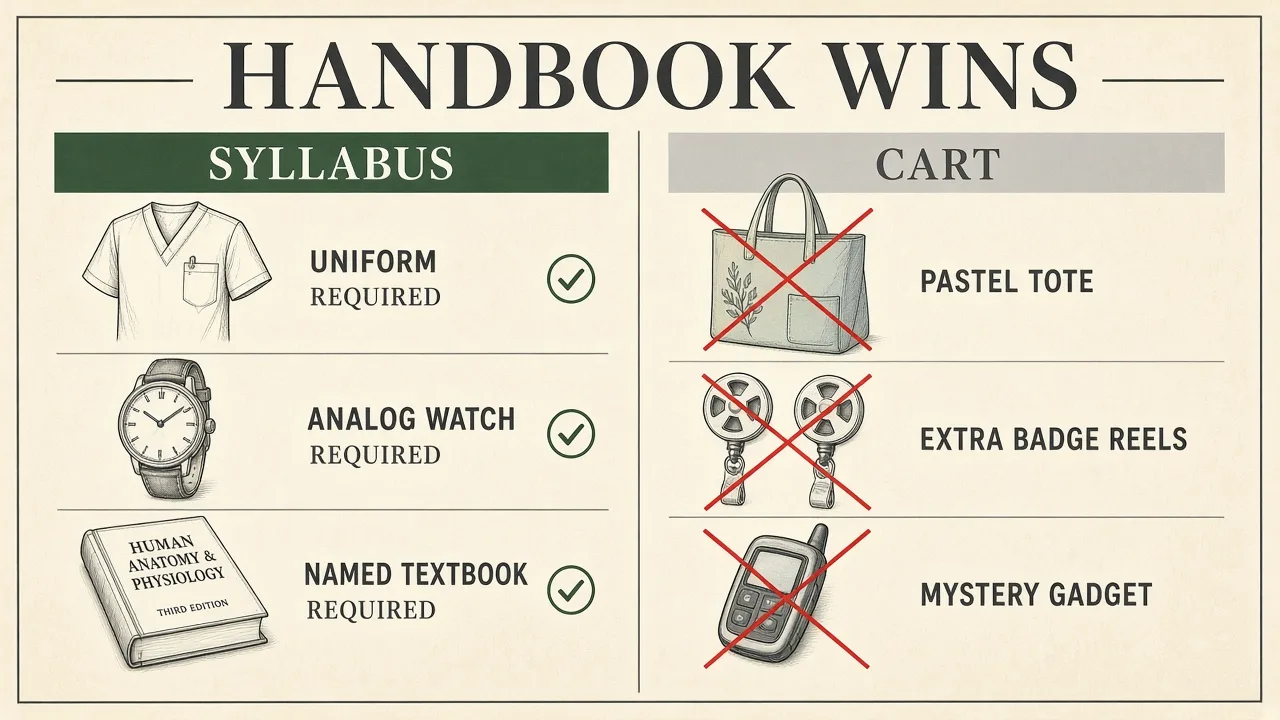
What you need for nursing school is the syllabus list, not the cart. Almost every U.S. program names black or facility shoes, a watch you can read in a dark room, the current fundamentals edition, and a clinical bag that will survive alcohol wipes. A Tulsa Target lot with a pastel tote, a monogrammed badge reel, and a 40-item classmate haul is the other list. Wait three weeks before you buy extras. Most of them declare themselves.
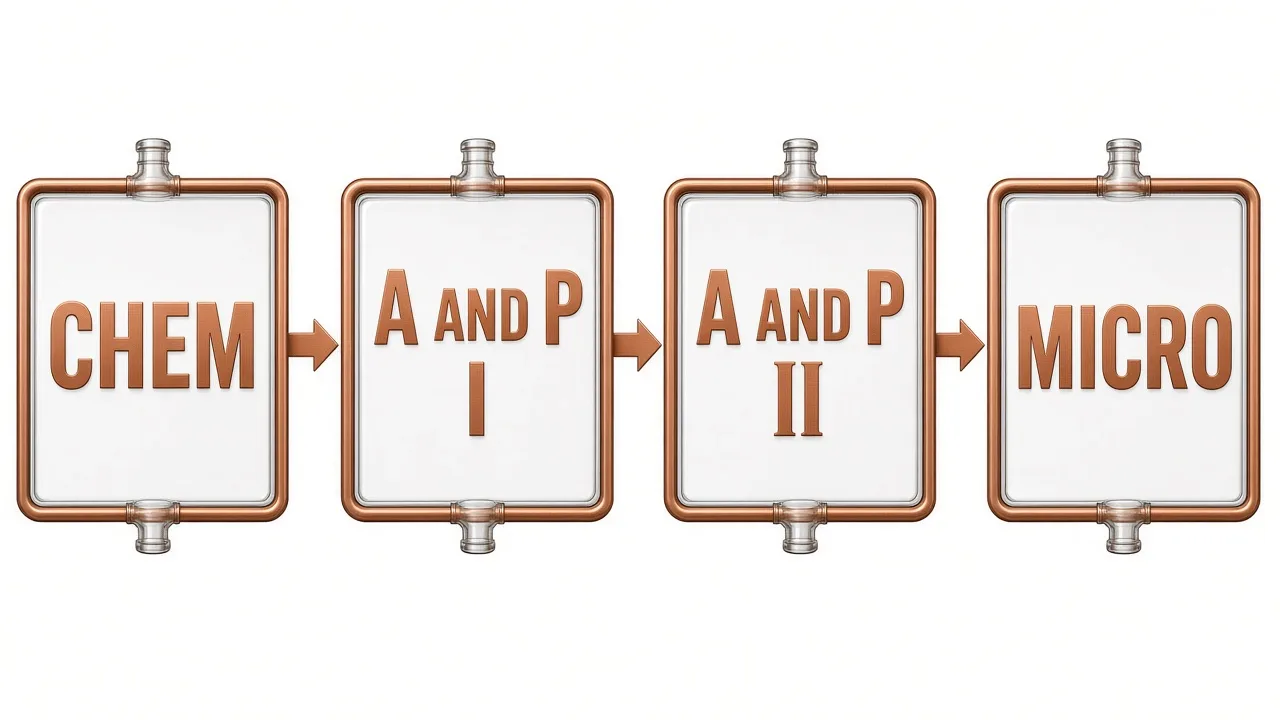
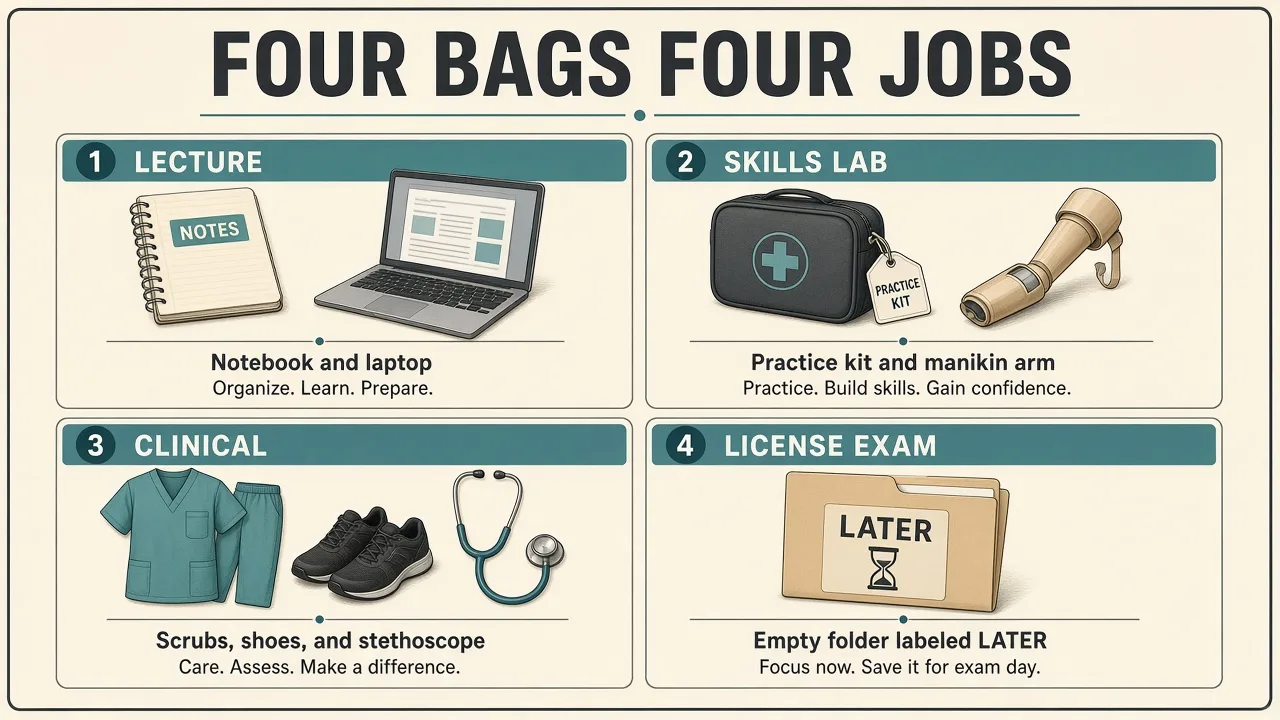
This guide is four bags: lecture, skills, clinical, and a later license exam. Prerequisites that unlock the seat live on the science sequence. Hidden months live on hidden clocks. The exam that sits in front of you now is an entrance test, a course exam, or later NCLEX-RN or NCLEX-PN.
Nursier does not sell shoes, scopes, or scrubs. We do not take a cut from a shopping link. We write this so you can leave the lot with the short list your program named, and so you can study the exam that actually sits in front of you: an entrance test now, a course exam later, or NCLEX-RN or NCLEX-PN when the license is close.
The syllabus list and the cart list
Every American nursing program publishes two documents that matter more than any influencer video. One is the orientation or student handbook. The other is the course syllabus. Those pages are local law. They name the shoe color, the watch, the edition, the immunization packet, and the brand of exam product the faculty already bought for the cohort. A national “nursing school packing list” cannot override a sentence that says “no smart watches in clinical.”
The cart list is everything else. It is built by ads, by fear, and by the pleasant feeling of buying a new identity. It is how a person who still needs a TEAS score ends up owning three badge reels and no quiet hour to sit TEAS 7 or HESI A2.
A method that fits on a sticky note
- Print the handbook page and the first-semester syllabi. Paper still wins when a phone is tired.
- Circle only the words “required,” “must,” and “no.” Those words spend money or save it.
- Put a date on anything that says “by the first clinical day.” That is a calendar, not a vibe.
- Leave every “recommended” item in a second column. Recommended is not required.
- Do not shop from memory in a bright aisle. Shop from the paper in your hand.
If you are still choosing a program, stop shopping. A tote will not fix a missing board approval. Read what accreditation and clinicals actually decide first. Supplies come after a real seat.
Four bags, four jobs
People buy one giant backpack and then hate it by week four because it was asked to be four different tools. Separate the jobs, even if two of them share a tote on Tuesday.
| Bag | What it is for | What belongs in it | What does not |
|---|---|---|---|
| Lecture | Classroom, library, kitchen table | Laptop or notebook, charger, water, the book that week actually uses | A full clinical kit, three extra scopes, a stuffed keychain that rattles |
| Skills lab | Practice on manikins and classmates | What the lab syllabus named: often a kit, a penlight, a watch, hair up | Food, loose jewelry, the good shoes you need dry for clinical tomorrow |
| Clinical | A unit, a clinic, a long-term care floor | Clean uniform, closed-toe shoes, analog watch, pen, badge, a small snack you can eat off the floor plan | Valuables, extra rings, a smart watch if the site forbids it, yesterday’s coffee |
| License exam | A later Pearson seat, not week one | A government ID and the appointment you already paid | A new “NCLEX backpack” bought in August of first semester |
The license bag is empty on purpose. NCLEX is a later fee and a later calendar. We already mapped that money in NCLEX cost in 2026 and the 2027 increase. Nursier does not collect that fee. Do not let a week-one haul pretend it is exam prep.
Keep, wait, skip
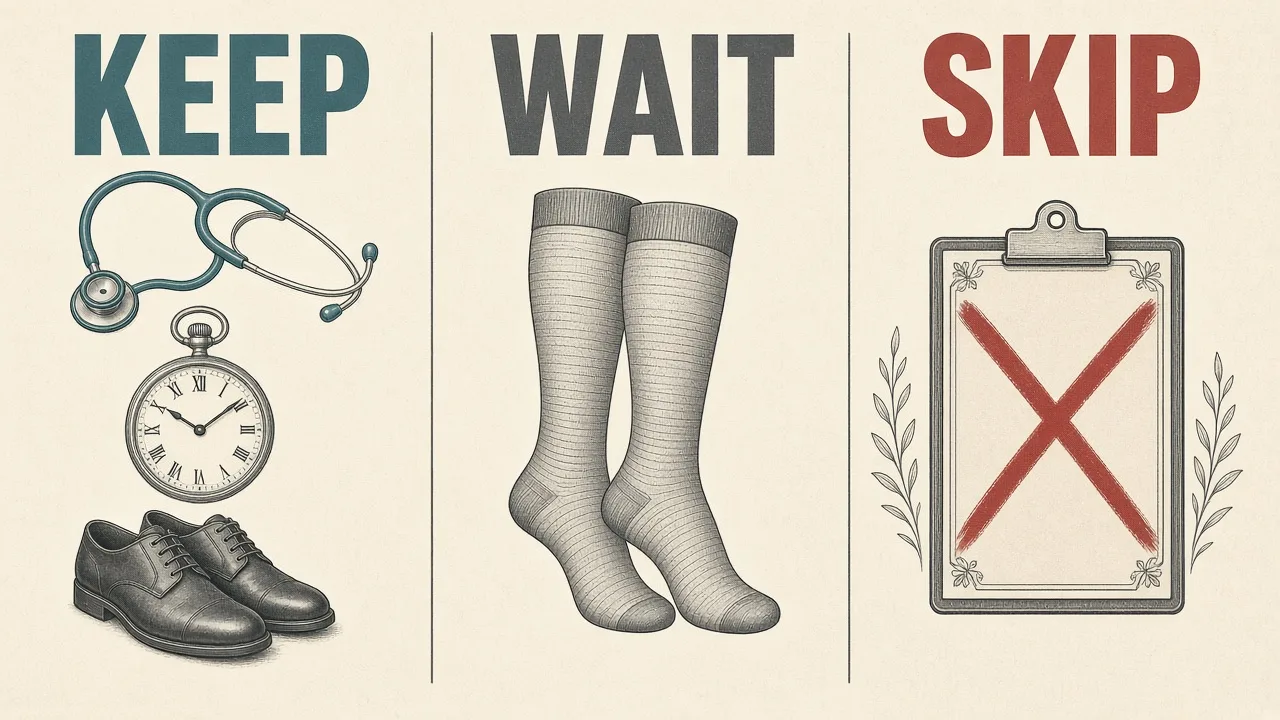
This is the whole article in twelve lines. The rest is evidence.
| Keep this week | Wait three weeks | Skip unless your paper says it |
|---|---|---|
| The named edition, or the access code the faculty already assigned | A second stethoscope “for home” | Matching pastel sets sold as a personality |
| Closed-toe, closed-heel shoes in the color the handbook named | A compression-sock wardrobe | A monogrammed everything |
| A watch you can read in a dim room, with a second hand if they asked for one | A badge reel in every color | A “nurse starter kit” whose contents you cannot name |
| The immunization and background-check packet, on their deadline | A rolling bag | A smart pen you will not charge |
| A laptop that can open the school portal and a webcam if lecture is remote | A tablet “just for anatomy” | A decorative clipboard you will not take to a unit |
Three weeks is not a superstition. By then you have seen the lab, heard the instructor’s pet peeve, and learned whether your cohort shares a kit. You will also know whether you even like the program. A person who withdraws in week two should not also be returning a closet of unused merch.
What almost every U.S. program actually names
We will not publish a fake national shopping list with prices. Those lists go stale in a season, and they quietly turn one school’s rule into everyone’s rule. What follows is the pattern that shows up in ordinary American handbooks. Confirm each line on your own PDF.
| Item | Why programs name it | The question to ask |
|---|---|---|
| Uniform and shoe rule | Sites want you recognizable and safe on a wet floor | Color, logo, and whether sneakers are allowed |
| Watch | Pulses, respirations, and med windows still use a second hand | Analog only, or is a simple digital face allowed |
| Stethoscope | Skills checkoffs and many clinical days | Do they issue one, or do you buy, and is a specific bell required |
| Skills kit | Practice supplies the lab does not want to restock for free | Is the kit sold in the bookstore, and can last year’s kit transfer |
| Named textbooks and codes | Homework lives in a publisher portal | Code required, or will a used book plus a cheaper code work |
| Exam product login | ATI, HESI, or another school-paid bank | Did tuition already include it, or is there a separate shop |
| Health packet | Hospitals will not badge you without it | Which titers, which flu date, which background vendor |
| ID and parking | You cannot wander a unit as a guest | School badge, site badge, and where you leave the car |
Notice what is missing. A color-coded highlighter set is missing. A $400 “professional” scope is missing. A new iPad is missing. Those can be useful later. They are not the first-week law.
If you are still waiting on a school seat, the object you need may not be a bag at all. It may be a score report. Sit TEAS 7 or HESI A2, whichever the catalog named, before you embroider a tote.
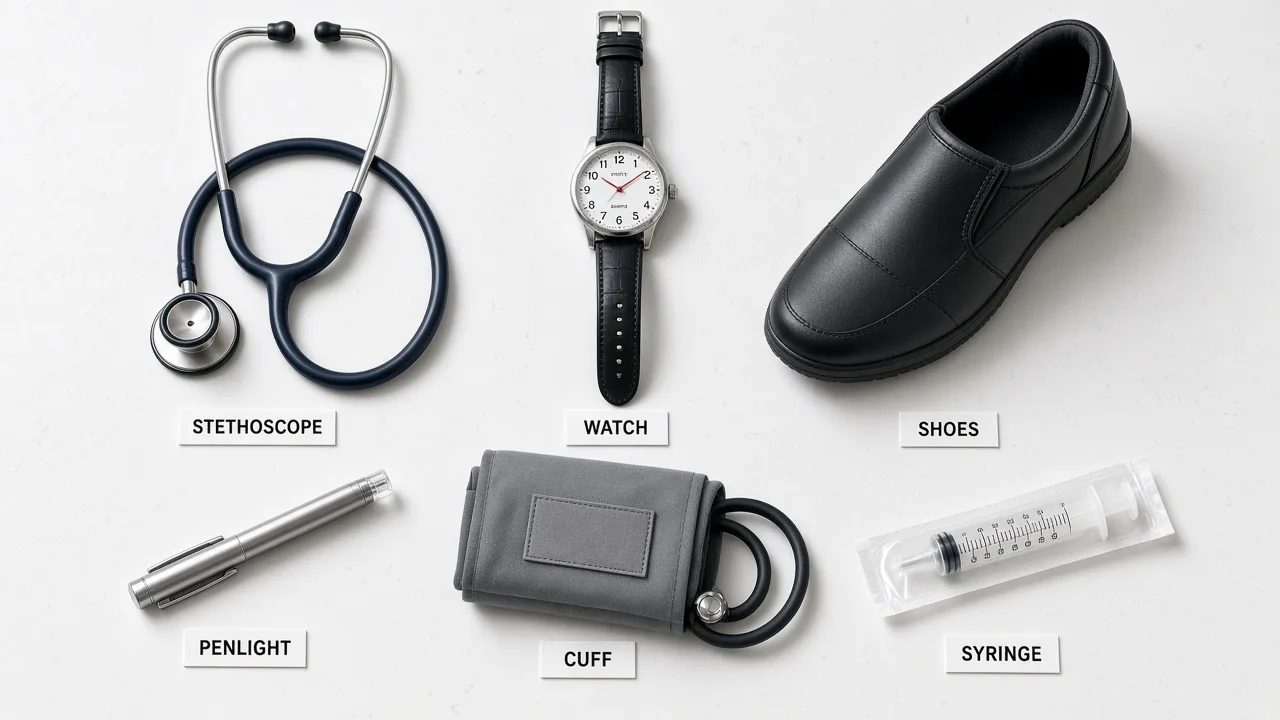
Stethoscope, shoes, and a watch
The stethoscope
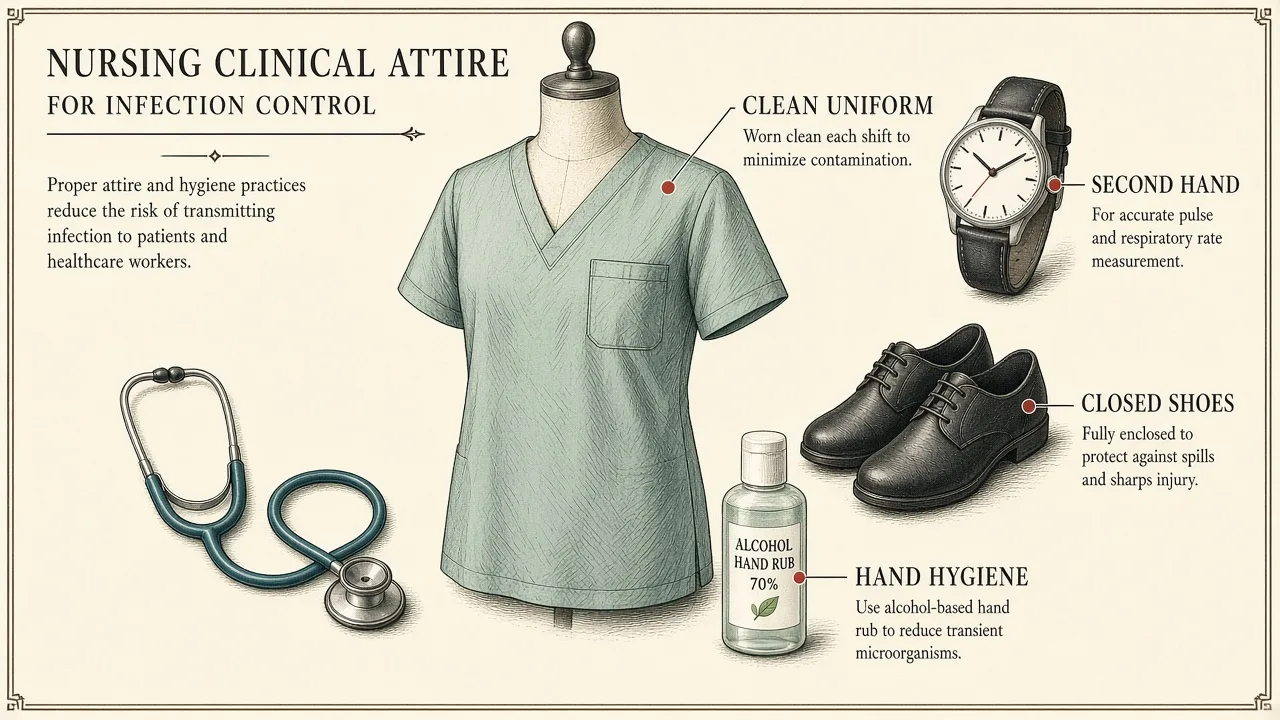
You need to hear a blood pressure and a few heart and lung sounds well enough to pass a checkoff and to report what you heard. You do not need a cardiology-grade instrument in week one. Faculty who love a certain brand will say so. If they do not, buy a mid-weight dual-head scope you can clean, with tubing that is not so long it knocks into a bed rail. Try it on your own arm in the store if they will let you. If you cannot hear your own brachial pulse in a quiet aisle, you will not hear a frail one in a noisy hallway.
Engrave it or mark the tubing. Scopes walk. Do not buy a second “home scope” until the first one has survived a month. Pediatric or teaching heads can wait until a pediatric rotation names them.
The shoes
Closed toe and closed heel are the usual rule because spilled fluid and dropped objects do not respect fashion. Comfort is not vanity here. A twelve-hour day on a unit will find the cheap seam. Walk on a hard floor in the store. If the heel slips, it will slip with a wet tile. Black or white is a handbook question, not a style question. Replace them when the tread goes or when they stay wet. Do not share clinical shoes with the grocery run if you can help it. You walk through enough of other people’s days already.
The watch
If the handbook says analog, believe it. A second hand still earns its keep when a pulse is irregular and a monitor is not yours to trust yet. A smart watch can be a gift and a problem on the same day. Some sites treat it like a phone. Some faculty treat it like cheating in skills. If they banned it, leave it in the car. A $20 face you can read at 3 a.m. is a better tool than a bright rectangle that buzzes a text from home.
Books, access codes, and the used-book trap
The expensive surprise is rarely the hardcover. It is the code that unlocks the homework. A used book without the code is a paperweight if the faculty graded last week’s quiz in the publisher portal. Ask, in writing, whether the code is required this term. Ask whether last year’s code still opens. Ask whether the library keeps a reserve copy for the chapters you only need to read.
When a program already paid for ATI or HESI as part of tuition, do not buy a second unofficial “same thing” from a stranger’s link. Official seats stay with those companies. Nursier practice is unofficial. We say that on purpose. If you want extra questions in the same season, sit unofficial RN practice once you are in an RN track, or LPN practice if you already hold a practical or vocational license.
End-of-chapter homework is a different job from an entrance exam. If your course still assigns it, use nursing book questions for that work. Do not mix it with a TEAS timer. The two scores do not travel together.
Tech that matters, gadgets that do not
- A laptop that opens the portal. Chromebooks fail some proctoring windows. Ask the school which browsers and which lockdown tools they use before you buy a new machine.
- A charger you keep in the lecture bag. A dead battery in a pop quiz is not a supplies problem. It is a day problem.
- A webcam and a quiet corner if any test is remote. A ring light is optional. A door that closes is not.
- Wifi you have tested at the hour you will sit. Evening congestion on a shared apartment line has failed more exams than a missing highlighter.
- Skip the smart pen, the wearable camera, and the anatomy tablet until a course names them. Most people use the phone they already own and one notebook.
If lecture is online, the tool is still a real program with real clinicals. A webcam is not a license. Confirm accreditation and clinicals before you shop a microphone.
Clothes, nails, and the clinical bag
Units write dress codes because clothing is part of infection control, not because they dislike your taste. The public sources are blunt. CDC hand hygiene guidance still starts with soap, water, and alcohol rub, and it still cares about what sits on your hands. Long nails and extra rings collect what you just washed off. CDC isolation precautions for health care personnel assume you can glove, gown, and wash without fighting a pile of bracelets. SHEA’s expert guidance on attire in non-operating-room settings is the paper faculty quietly borrow when they ban fabric cuffs that drag and neckties that swing into a tray. Read the public version at SHEA on health care personnel attire.
OSHA’s bloodborne pathogens standard is why your school talks about fluids as if they were a schedule, not a scare. The rule lives at 29 CFR 1910.1030. You do not need to recite the number. You do need shoes you can wipe, a uniform you can wash hot, and a bag that is not also your gym bag.
A clinical bag that will not embarrass you
- Clean uniform on a hanger, not stuffed over last night’s leftovers.
- Closed shoes that are dry.
- Watch, pens that write, one small notebook, one penlight if they asked.
- Stethoscope in a clean pocket, tubing not dragging.
- School ID and any site badge.
- A snack that does not smell across a med room.
- A zip bag for a phone if the site allows a phone at all.
- Nothing you would cry about if a locker failed.
Hair up if it can fall forward. Facial hair trimmed if a respirator fit test is on the calendar. Fragrance light enough that a nauseated patient can share the room. None of that is personality advice. It is how you stay invited back.
Onboarding shots are not “supplies,” but they block the badge. CDC’s adult vaccine page for health care personnel is the national starting point. Your hospital packet is the local law. Start the titer chase early. A late varicella result has delayed more first clinical days than a missing clipboard.
What classmates will try to sell you
Cohorts form little markets. Someone’s cousin sells embroidery. Someone’s roommate has leftover kits. Someone found a “discount official account.” Slow down.
- Used skills kits. Fine if the lab says so and the sterile pieces are still sealed. Not fine if the Foley is open and the instructor grades a first-open.
- Last year’s codes. Ask the publisher window, not the seller.
- Shared quiz banks with a strange login. If it feels like a leaked exam, walk away. Boards and schools treat that as a conduct problem, not a study hack.
- Embroidery on a clinical top. Cute until the site says no personalization. Ask first.
- A “guaranteed pass” bundle. Nobody who is honest sells a guarantee. Nursier does not sell one either.
Be kind in the group chat. You do not need to police other people’s tote. You do need to protect your rent.
How to spend without a fake national budget
We will not invent a “typical nursing student spends $X” figure. Those posts pick a private-school cart and a public-school cart and then average them into a number that fits nobody’s kitchen. Use tools that already exist, and add only the lines your PDF named.
- College Scorecard for the institution’s average annual cost and borrowing, with the usual limits of school-level data.
- Your school’s net-price calculator, with your real household numbers.
- Federal Student Aid’s aid types if you are deciding whether a new laptop belongs on a loan.
- The bookstore return window, photographed on day one.
- The hospital’s badge fee and parking fee, which catalogs forget.
If you must put something on a card, put the required code and the shoes you will stand in, not the third water bottle. A person working nights at a grocery store already knows this. The ads pretend they forgot.
Unofficial practice, if you add it, is not a skills kit and it is not a Pearson seat. Check what Nursier currently charges before you put it on a month that already has shoes and an access code. We do not bundle a stethoscope.
After the bag is packed
The useful test of a packed bag is silence. If you can zip it without a pep talk, you bought enough. Then stop shopping. Shopping feels like studying. It is not. The exam in front of you is still the exam in front of you.
If the catalog still wants an entrance score, sit a short set for that exam. If you are already inside a program, keep lecture and skills in their lanes. If graduation is close, study the license exam you will actually see. Those seats are not interchangeable, and a new tote will not sit them for you.
The Nursier editorial team wrote this. We do not take your program deposit, your shop receipt, or your NCLEX fee.
Common questions
Do I need to buy everything before the first day?
You need what the first-day and first-clinical sentences name. Everything else can wait until you have seen the lab. A person who buys the whole internet in August is usually selling half of it in October.
Is a cheap stethoscope a mistake?
A toy is a mistake. A mid-weight scope you can hear with is not. If you cannot hear your own pulse in a quiet room, return it. If faculty name a model for a later rotation, buy that later.
Can I wear a smart watch in clinical?
Only if the handbook and the site both allow it. Many do not. An analog face still works when a policy changes on Thursday.
Should I buy ATI or HESI on my own?
Not if tuition already includes the product your faculty will grade. Official registration stays with those companies. Unofficial extra practice is a different purchase. Nursier does not sell ATI or HESI.
I am an LPN going back for RN. Do I need a new bag?
You probably already own shoes and a scope. Read the new handbook anyway. Some RN sites are stricter than your current unit. Keep PN exams and RN exams apart. If ATI LPN or HESI LPN is the test in front of you now, study that one.
What if I cannot afford the kit this month?
Ask the program director, the bookstore payment plan, and the campus emergency fund before you put a kit on a high-interest card. Faculty have heard this sentence. Silence is more expensive than an honest email.
Sources
Confirm live pages. Handbooks beat blogs, including this one.
- CDC, about hand hygiene
- CDC, hand hygiene clinical safety for health care personnel
- CDC, isolation precautions for health care personnel
- CDC, vaccines for adults, including health care personnel
- OSHA, Bloodborne Pathogens standard, 29 CFR 1910.1030
- OSHA, bloodborne pathogens topic page
- SHEA, health care personnel attire in non-operating-room settings
- SHEA attire guidance, free full text at PMC
- College Scorecard
- Federal Student Aid, types of aid
- NCLEX fees and payment
- NCSBN, approval of nursing education programs
- AACN Essentials FAQs
Nursier is independent. We are not affiliated with, endorsed by, or sponsored by NCSBN, Pearson VUE, ATI, Elsevier, CDC, OSHA, SHEA, or any nursing program. This article is planning copy. It is not a school handbook, and it is not a product endorsement.