How the Nurse Licensure Compact works when you move or travel
The Nurse Licensure Compact lets a nurse who lives in a compact jurisdiction and holds a multistate license practice in other compact jurisdictions without a second single-state license. A 13-week Florida travel contract on an Oklahoma multistate license keeps Oklahoma as home. A Dallas offer with a lease, a school district, and house keys is a move. The compact cares which one you are doing. It does not care that both jobs sit in compact states.
This guide is primary state of residence, the 60-day rule, travel versus a move, and why we will not count states — NCSBN and NurseCompact.com keep the live map. If you do not yet hold an RN or LPN license, start with how to become a nurse. LPN versus RN stays on two licenses. Remote work still follows the member: the member has a state.
How the Nurse Licensure Compact actually works
The Nurse Licensure Compact lets a nurse who lives in a compact jurisdiction and holds a multistate license practice in other compact jurisdictions without a second single-state license. NCSBN says it in those words: practice in other NLC states without obtaining additional licenses. Read NCSBN’s Nurse Licensure Compact page and the public site NurseCompact.com.
It does not cover every U.S. jurisdiction. It does not cover a non-compact state you want to work in. It does not cover an aide registry. It does not cover nurse practitioners. A Facebook map from 2022 is not a privilege. Open the live map the week you sign a lease or a travel contract.
NC-SARA is a different compact. It helps colleges offer distance education. It is not a nursing license. Do not mix the two because they share a word.

Primary state of residence
On every multistate application, you declare a primary state of residence. The compact rules say a party state may ask for evidence. The list is public: a driver’s license with a home address, a voter registration card with a home address, a federal income tax return that declares the state, military form 2058, or a federal W-2 that shows residence. Read those examples in the NLC rules (PDF).
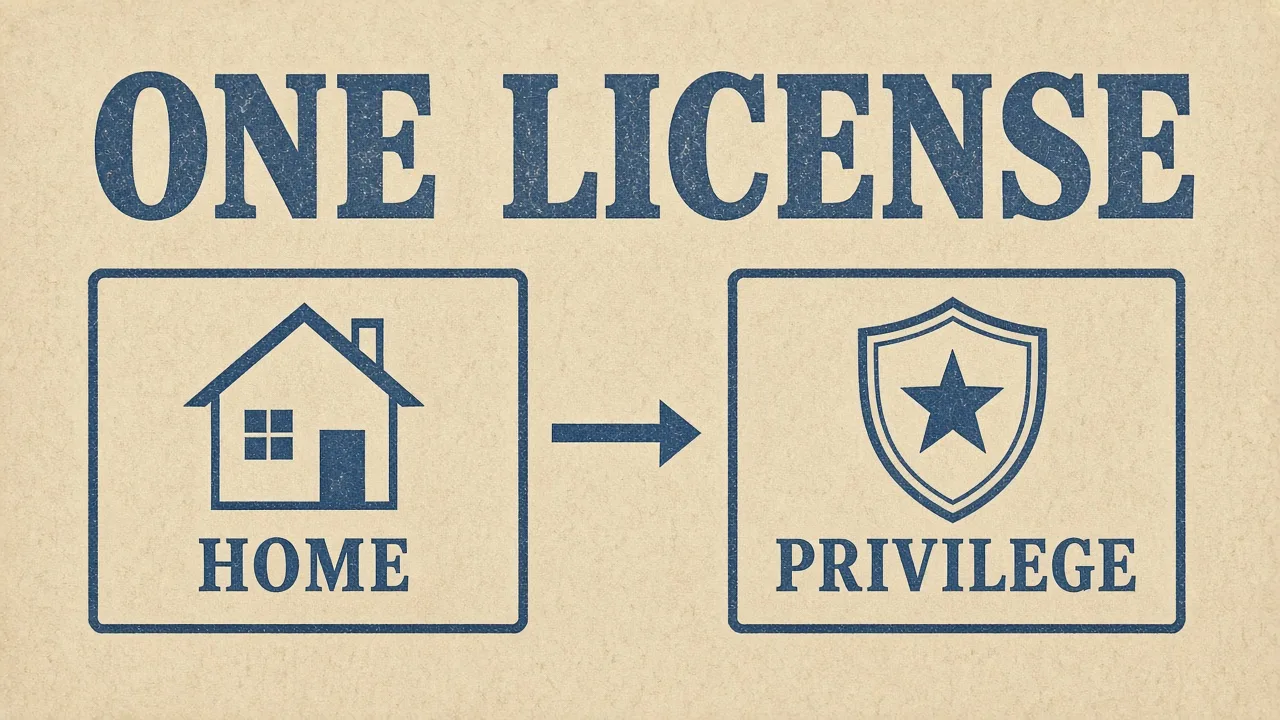
The home state is the only state that issues your multistate license. Other compact states recognize a privilege. If you are not eligible for a multistate license, the home state may still issue a single-state license under its own law. That single-state license does not travel. Do not assume “Oklahoma license” means “Oklahoma multistate.” Read the license type on the board’s lookup or on Nursys.
A foreign citizen who is lawfully present may declare either the country of origin or the party state where they live. If they declare the foreign country as primary residence, the party state shall not issue a multistate license. It may issue a single-state license if the applicant meets that state’s rules. That is in the same rule set. Do not invent a workaround on a forum.

The 60-day rule
As of January 2, 2024, a multistate licensee who changes primary state of residence to another compact state shall apply for a multistate license in the new party state within 60 days. The Interstate Commission said so when it adopted the amended rule. The application is licensure by endorsement on the new board’s site. The new license does not have to be issued inside 60 days. The 60 days begin when you arrive with the intent that this state is now home. Read NCSBN’s residency-rule news and the 60-day rule FAQs (PDF).
NurseCompact’s moving scenarios are the practical version. When you relocate to another compact state, you apply in the new primary state within 60 days. You must have a license in the state where you reside. You may practice on the former home-state license only until the new multistate license is issued. When the new one is issued, the former one is deactivated. Read Moving Scenarios (PDF).
Bring proof of the new home when you apply. The employer FAQ says a new-state driver’s license or voter registration is the usual evidence, because those documents include a legal attestation. The new board’s application will name what it will accept. Do not wait for a perfect week. The clock started when the keys turned.

A travel assignment is not a move
The 60-day FAQ asks the travel question directly. A nurse whose primary state is Ohio, who holds an Ohio compact license, who takes a 13-week assignment in Florida and then returns to Ohio, does not apply for a Florida license. Florida is temporary. Ohio remains home. The nurse practices in Florida under the Ohio multistate license. The 60-day rule does not apply.
That is why the Lawton driveway matters. Last year’s Florida contract was travel. This year’s Dallas lease is a change of primary state of residence, if Texas is now home. Ask yourself out loud: where is my driver’s license going, where do I vote, where do I file, and do I intend to return. If the answers moved, apply. If they did not, keep the home-state license and confirm both states are still compact on the live map the week you start.
Employers have their own one-pager. The rule pertains to nurses who hold an active RN or LPN/VN multistate license and who are making a permanent move to another NLC state. It does not invent a new license for a traveler who kept the old home. Read the employer 60-day guidance (PDF).
You hold one multistate license
The rules are jealous on purpose. A remote party state shall not issue a single-state license to a nurse who already holds a multistate license. A nurse shall not apply for a single-state license in a remote state while holding a multistate license in the primary state of residence. When a new home state issues a multistate license, party states deactivate the old one. You do not collect compact licenses like stamps.
If you need to work in a non-compact state, that is endorsement into that state, one board at a time. The compact privilege does not reach there. If you need to work as an NP, that is a different credential. A compact RN does not become a compact NP because the hospital badge says both words.
If your home is not in the compact
You still become a nurse. You apply in that state. You sit NCLEX-RN or the PN exam the board named. You add other states later by endorsement if you need them. The compact is a later convenience, not a reason to skip an approved program. If you later move into a compact state and become eligible, that board’s multistate application is the door. Do not treat a non-compact home license as a privilege in Texas because a recruiter said “everyone is compact now.”
The APRN compact is a different instrument
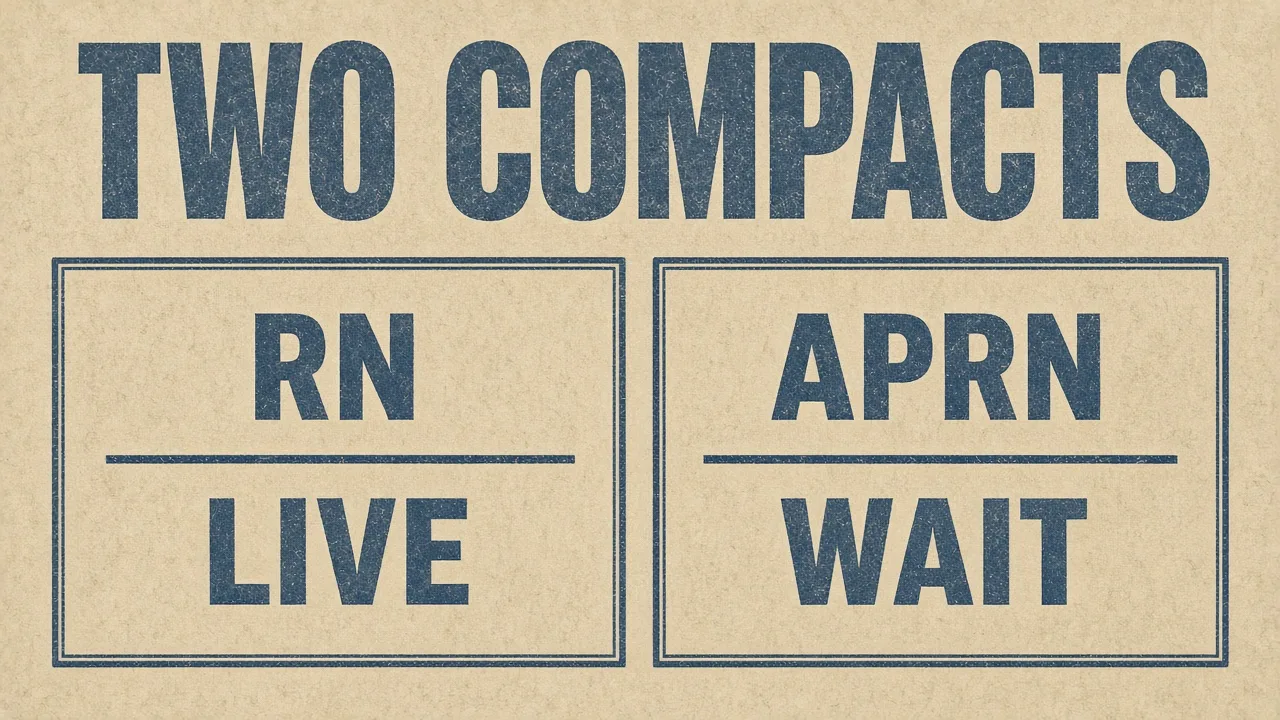
NCSBN publishes two compact stories on one page. The NLC is operating. An APRN compact, NCSBN says, will increase access to care when it exists. The 2020 adopted APRN Compact text still required seven party states before a commission could even convene. In 2026, NCSBN’s board charged staff to redesign the APRN compact with boards of nursing. That work is underway. It is not a live privilege. Read NCSBN on licensure compacts and the NP program guide for the credential that actually exists: role, population, certification, then the board where you will practice.
Aides are not in this compact
The Nurse Licensure Compact is for nurses. A CNA or nurse aide registry is a state list. Reciprocity, if it exists, is a courtesy between registries. It is not an NLC privilege. If you are still on the aide door, read the registry and the exam that is not NCLEX. Do not tell an aide that “compact covers it.”
Look the license up
Nursys is NCSBN’s public licensure database for participating boards. Employers and nurses use it to see a license type and a status. It is not a substitute for the board’s own application. It is how you confirm whether the license in your pocket is actually multistate before you accept a start date two states over. Start at Nursys.com, then open the home board if anything looks thin.
Discipline travels in the compact world. A privilege can be affected when a home state or a remote state acts. Do not treat a clean Nursys row from last spring as permission to ignore a current order. Read the current row the week you start.
After you know the home state
Write four facts on a card: the primary state, whether the license is multistate, whether the next job is travel or a move, and the date you arrived if you already moved. If you moved, start the endorsement application. If you are traveling, confirm both states on the live map. If the next task is still NCLEX, leave the compact map alone and study the exam in front of you.
Unofficial RN practice or LPN practice belongs with the license you already hold or still need. Sit practice questions when the work is a question set, not a lease. The Nursier editorial team wrote this.
We do not collect board fees. We do not collect Nursys fees. We do not issue a privilege. Your board keeps those payments.
Common questions
How many states are in the compact?
The number moves. We will not print a count that will be wrong next month. Open the live map on NurseCompact.com the week you need it.
Do I have 60 days to get the new license in my hand?
No. You have 60 days to apply in the new primary state. The board can take longer to issue. You may practice on the former multistate license until the new one is issued, then the old one goes away.
I am traveling for 13 weeks. Do I need a new license?
Not if you kept the old primary state and both states are compact. If you are moving, apply. The FAQ’s Ohio-to-Florida example is the test. Your pair will be different.
Does a compact RN license cover NP work?
No. The NLC is RN and LPN/VN. An APRN compact is not a live privilege you can use next Tuesday. Apply to the board where you will practice as an NP.
My home state is not compact. Can I still work in a compact state?
You apply to that state’s board for a single-state license, if they will issue one to a non-resident. The compact privilege is not yours until you hold a multistate license from a compact home.
Does the compact replace NCLEX?
No. You still finish an approved program and sit the exam the board named. The compact is a later mobility tool. It is not a shortcut around the first license.
Sources
Confirm the live map. Jurisdictions move.
- NCSBN, Nurse Licensure Compact
- NCSBN, licensure compacts
- NurseCompact.com
- Interstate Commission, NLC rules (PDF)
- NCSBN, new residency rule
- NLC, 60-day rule FAQs (PDF)
- NLC, 60-day rule guidance for employers (PDF)
- NLC, moving scenarios (PDF)
- Nursys license lookup
Nursier is independent. We are not affiliated with, endorsed by, or sponsored by NCSBN, the Interstate Commission of Nurse Licensure Compact Administrators, or any state board. This article is planning copy. It is not a license, and it is not a list of compact states.