Nursing prerequisites: the science sequence that actually unlocks a seat
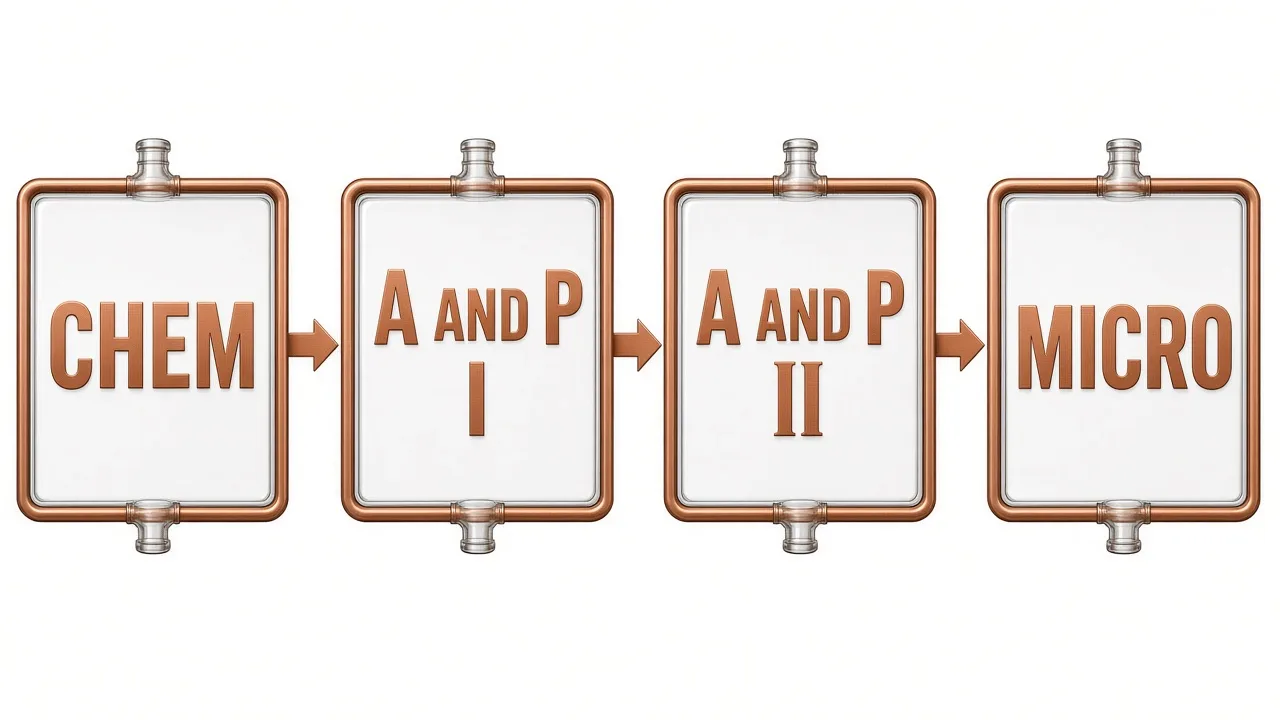
Most U.S. nursing catalogs are a chain, not a pile: chemistry before anatomy and physiology, A&P I before II, microbiology with its own lab, and recency rules that can retire an eight-year-old A&P. A Salt Lake lab-coat receipt will not move a point on a sheet that weights science GPA. The sequence will.
This guide is the map of names you will likely see, plus recency, transfer traps, and when to sit science versus the entrance exam. What to pack lives on what you actually need for nursing school. Hidden months live on hidden clocks. The folder lives on the packet around the exam.
Which science courses nursing programs actually require
BLS still starts registered nursing from an approved program and a license. The program starts you from named courses. There is no honest national prerequisite list with credit hours we can invent. There is a pattern U.S. associate and bachelor programs keep writing. Read BLS, registered nurses for the door, then highlight your PDF for the chain.
Nursier does not run a science department. We do not take a lab fee. Those colleges keep those payments.
The science sequence most catalogs actually write
Use this as a map of names you will likely see, not as a promise that your school wants every row.
| Course people say | What the catalog often means | What cannot substitute |
|---|---|---|
| Chemistry | Intro or general chem with lab, sometimes a chemistry-for-health course | A nutrition lecture with “some chemistry” |
| Anatomy and physiology I | Human A&P with lab, often after chem | Survey biology, zoology, or “body systems” without a lab |
| Anatomy and physiology II | The second human semester, often a direct sequel | Repeating A&P I and calling it II |
| Microbiology | Micro with lab, sometimes after A&P or chem | A public-health lecture with a germ chapter |
| Statistics or college algebra | The math the points sheet named | A high-school transcript and a shrug |
| English, psychology, lifespan | General-education rows that still hold a seat | Skipping them because science “matters more” |
Some bachelor programs want a full general-chem sequence, organic, or microbiology at a four-year depth. Some LPN bridges want less. The chain in front of you is the only chain. If two schools sit in the commute, keep two chains. Do not average them into “some science.”
Recency, grades, and the retake
- Many packets age science. Five or seven years is common. We will not invent yours. Highlight the sentence.
- A C may be enough to transfer and not enough to earn points. The points sheet is a second law.
- A D that you later replaced may still sit on a GPA rule. Ask whether they use the last grade or the first.
- Online lecture plus an in-person lab is not always accepted as their A&P. The lab location can be a line.
Transfer credits that look like science
Registrar language is colder than a Facebook group. Course titles that include “human” still fail if the credit hours or the lab hours do not match. Dual-credit anatomy from grade 11 can be too old by the time you apply at 24. Military corpsman training can be real skill and still not be their BIOL 241. Get the equivalency in writing before you skip a semester.
When to sit science versus the entrance exam
If the points sheet weights science GPA, finish the chain before you spend a month on a retake of TEAS for two extra composite points. If the last test date is sooner than the last chem seat, sit the named exam and put chem on the next term. The calendar article is how you place a month. This page is how you refuse to buy a lab coat instead of a chem seat. Keep the exam name on the catalog line.
What not to enroll in this month
Do not enroll in a random “nursing science bootcamp” that does not transfer. Do not sit two A&P I sections at two colleges hoping one sticks. Do not treat a tote haul as a prerequisite. If you need unofficial entrance practice after the chain is mapped, sit practice questions for the named exam. The Nursier editorial team wrote this.
After you map the sequence
Write every science row with term, grade, lab, and expiration. Circle the first missing link. Enroll in that link, not the coat. We do not take a lab fee.
Common questions
Can I take A&P I and II together?
Only if the catalog allows it. Most make II a sequel. A compressed summer pair is still two labs. Ask before you stack them on a 40-hour job.
Does AP credit count?
Sometimes for English. Less often for human A&P with lab. The equivalency office wins, not the high-school counselor’s memory.
Is this the supplies article?
No. Supplies are shoes, a watch, an edition. This page is the science chain that decides whether you start.
What if I already have a bachelor’s in biology?
You may still lack human A&P II with lab, or a recency window. Have the nursing advisor read the transcript. Do not assume a degree erases the chain.
Sources
Nursier is independent. We are not affiliated with BLS or any college. This article is planning copy. It is not a transfer evaluation, not a syllabus, and not a national prerequisite list.