How ADN programs actually admit: points, waitlists, and the same NCLEX-RN
An associate degree in nursing is an RN door. Graduates sit the same NCLEX-RN a bachelor graduate sits. What changes is the seat: community colleges often rank applicants with TEAS, biology, and GPA, then run a waitlist that may die when the term starts. A Raleigh advising worksheet with thirty-two seats is that math. Year zero is usually the science, not the brochure’s “two years.”
This guide is how those points work, why waitlists vanish, and what the two program years feel like. If you have not picked a license, start with how to become a nurse. LPN versus RN lives on two licenses. If the program is mostly online, read what accreditation and clinicals actually decide.
If you still have not picked a license, start with how to become a nurse in the U.S.. An ADN is one RN door. It is not a CNA course and it is not an LPN license. If the program you like is mostly online, read what accreditation and clinicals actually decide before you fall in love with a commute you will not make.
Nursier does not admit students. We do not run a community college. We write so you can read the worksheet the way the college already printed it.
What an ADN actually buys
An associate degree in nursing is a prelicensure RN program, most often housed at a community college, sometimes at a four-year school that still offers the associate track. Graduates who finish an approved program apply to their board and, if made eligible, sit NCLEX-RN. The Bureau of Labor Statistics is blunt about the three common education paths to registered nursing: a bachelor’s degree, an associate’s degree, or a diploma from an approved program, and then a license. Read that on the BLS registered nurse page.
AACN says the same exam fact in its education-impact sheet: diploma, associate, and baccalaureate graduates sit the same NCLEX-RN. AACN also says it will not campaign to close ADN programs, and that it still treats the BSN as the minimum preparation it wants for professional-level practice. Those are two sentences. Keep them apart. The first is about the license. The second is about a professional association’s preference. Read AACN on education and practice and AACN on ADN programs and articulation.
ANA’s public ADN-versus-BSN explainer is the kitchen-table version. An ADN is entry-level RN education, often about two academic years after prerequisites, usually at a community college. Some schools publish shorter calendars. Your PDF wins. Start at ANA, ADN vs. BSN.
What an ADN does not buy:
- A practical or vocational license. That is NCLEX-PN after an approved PN program.
- A nurse-aide registry card. That is a different exam your state names.
- A guarantee that every Magnet hospital will ignore the BSN box on a posting.
- A shorter NCLEX. The exam is the RN exam.
Year zero: the prerequisites
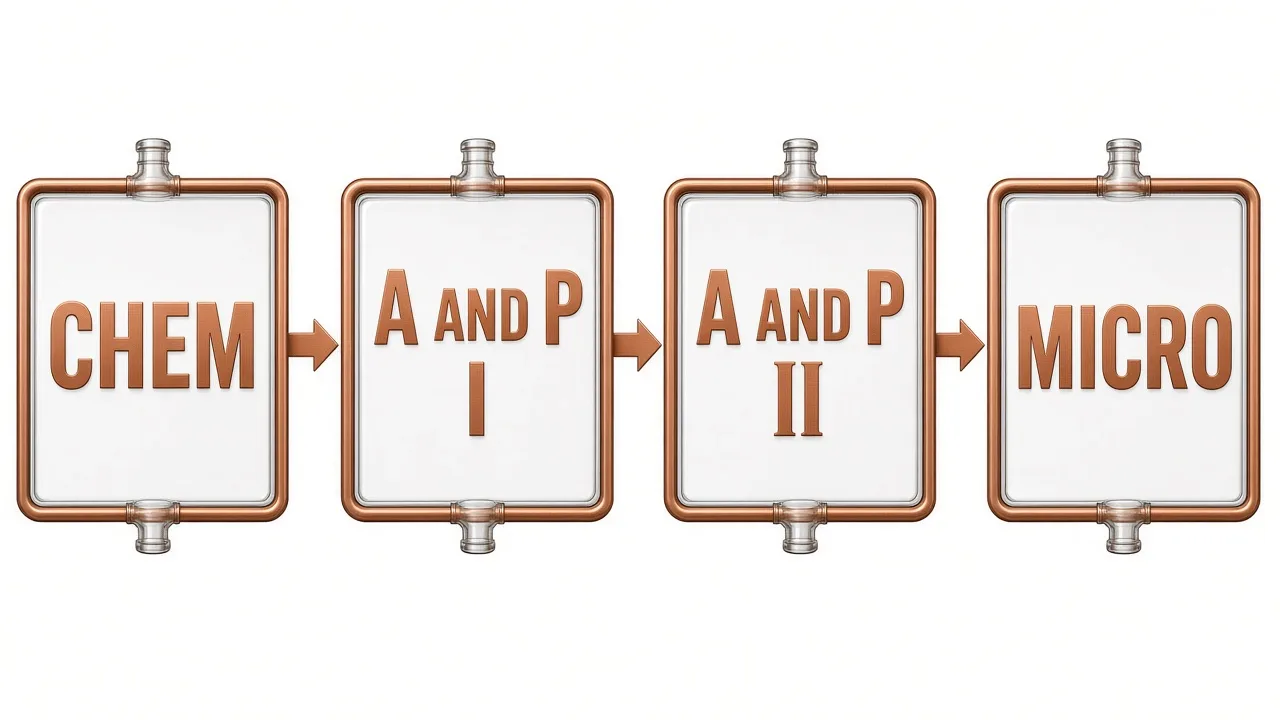
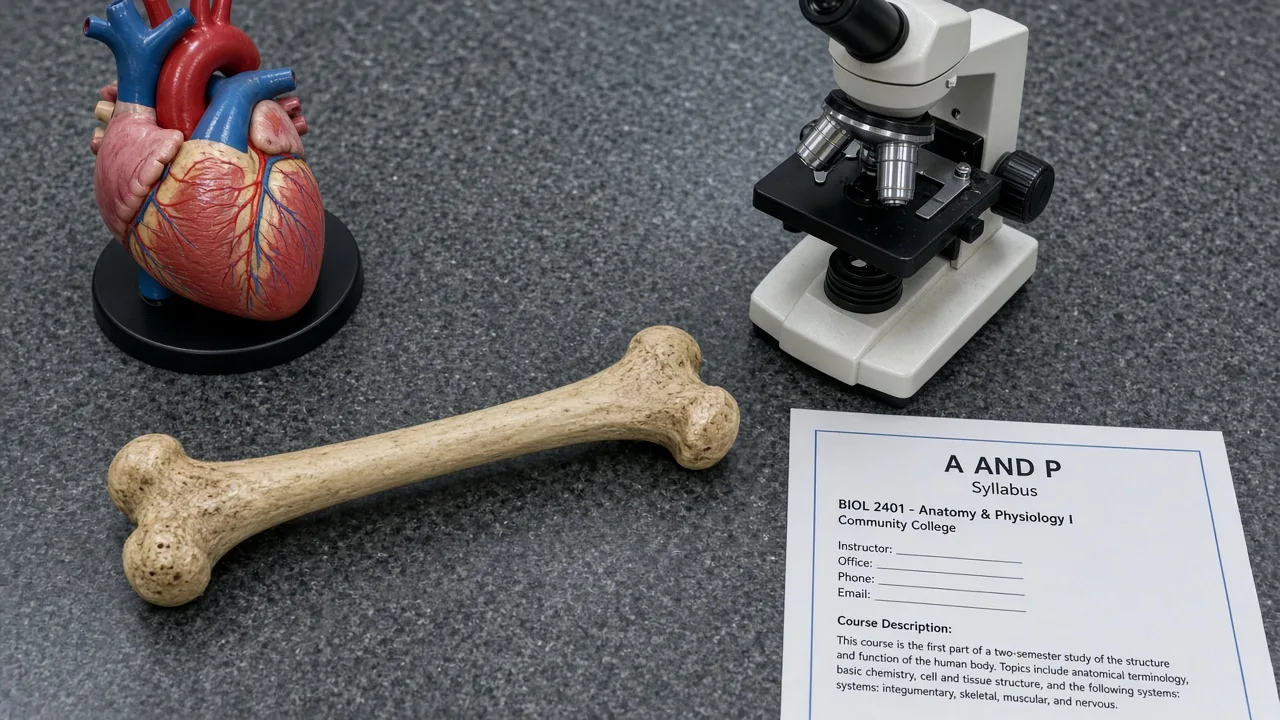
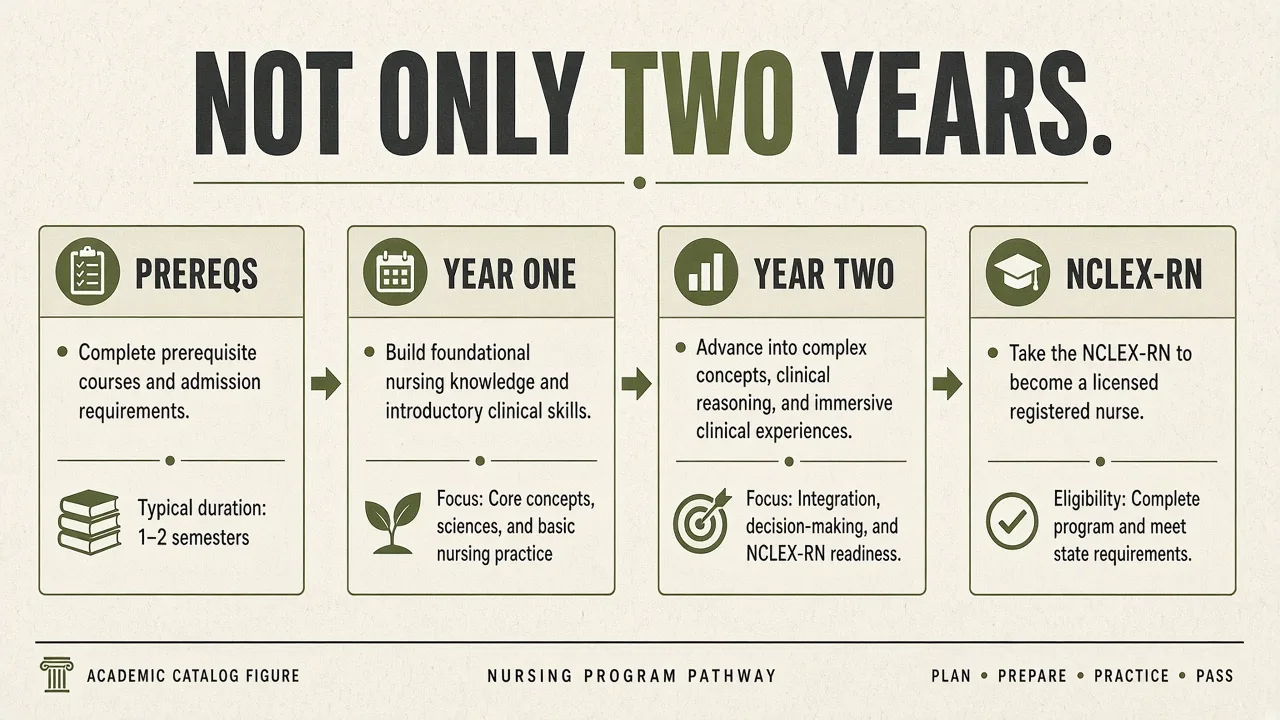
People say “ADN is two years.” They skip the year that made the two years possible. Community colleges publish their own science list. The pattern is familiar: anatomy and physiology with a lab, often a second A&P, microbiology, a chemistry, English, a math the program will accept, sometimes psychology. The grade floor is local. A “C is fine” rumor from a cousin in 2019 is not a 2027 packet.
Take the science at a school the nursing department already accepts. A cheap online anatomy that will not transfer is not cheap. Ask for the transfer table in writing. If you are still in those labs, you are not late. You are in the part that feeds the points formula.
Study the science as if a preceptor will ask you to explain it, because one will. Extra practice that matches a chapter belongs with nursing book questions. That is not an entrance exam, and it is not NCLEX.
How community colleges rank a seat
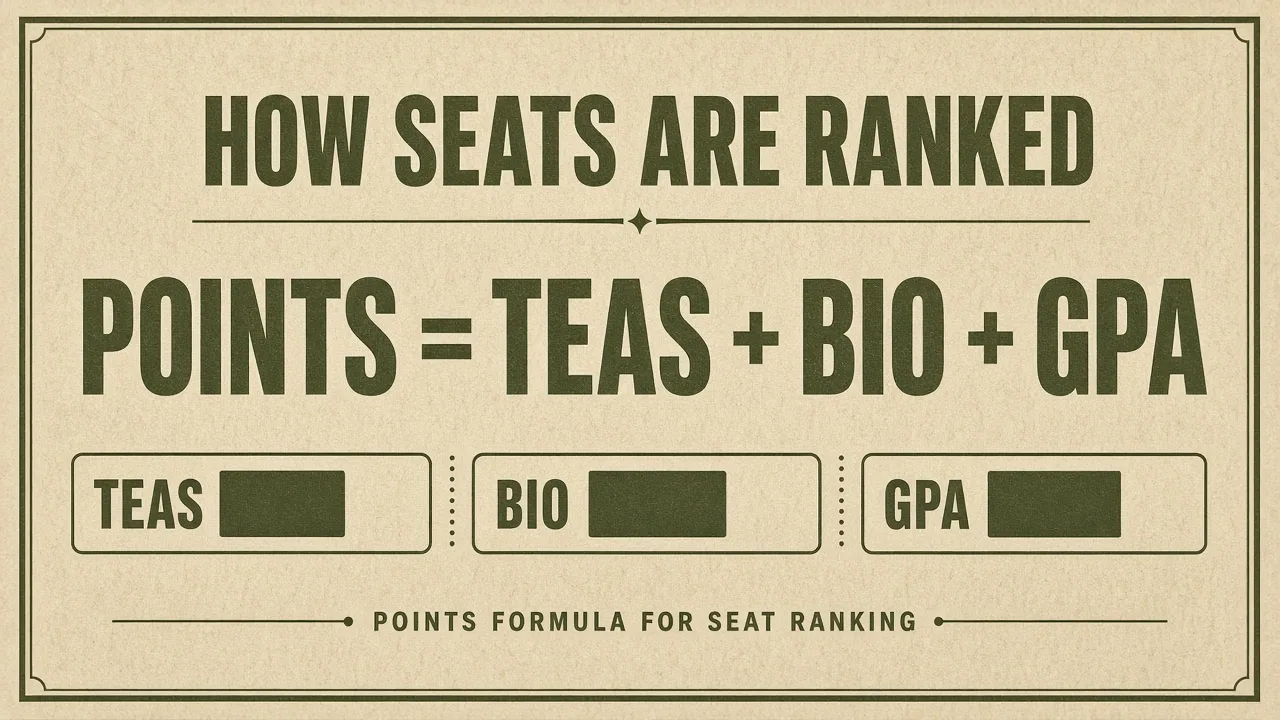
Selective ADN admission is a ranking problem with too few clinical slots. Colleges invent different arithmetic. Three public packets are enough to learn the method. They are not a national formula.
| College packet | How they rank | The sentence students miss |
|---|---|---|
| Craven Community College, North Carolina | TEAS total plus bonus points, then a ranked list | The waitlist is for that cohort only. When the semester starts, the list dies. You reapply. |
| CT State Community College | 25% TEAS, 25% Anatomy & Physiology I, 50% nursing admission GPA | A 58.7% TEAS floor. Most-recent score only. Waitlists are by campus and do not carry to next year. |
| Santa Barbara City College, California | Multi-criteria points; 80% highest points, 20% random among the rest | No waitlist. TEAS 7, 62% minimum, first attempt only. |
Read the packets yourself. Craven’s ADN rating sheet is a one-page education in how a seat is math. CT State’s 2027–2028 nursing information packet is the longer version, including how a refused campus offer can remove you for the year. Santa Barbara’s application requirements exist to kill the rumor that every California college keeps a friendly list.
If two colleges sit in your commute, write two formulas. Do not average them. A 62% TEAS floor and a 58.7% floor are not “about sixty.” They are different doors. Prepare for TEAS 7 if that is the named exam. If the catalog says HESI A2, that is a different packet. Prepare for HESI A2. They are not interchangeable. Nursier does not sell either seat.
Waitlists that do not roll over
Americans treat a waitlist like a deli ticket. Nursing waitlists often are not. Craven says remaining qualified applicants sit on a list for vacancies before the program starts, and everyone is removed when the semester begins. CT State says the waitlist will not carry from year to year. Santa Barbara says it keeps no list at all.
So the useful questions are local:
- Is there a waitlist, or only a ranked cut?
- Does the list die when the term starts?
- If I refuse a night cohort, am I out for the year?
- Do I have to retake TEAS if I reapply, and do they keep the first attempt or the latest?
A person who “has been on the list for three years” at a college that wipes the list every August is not on a list. They are reapplying and calling it waiting. Ask for the sentence in the PDF.
What the two program years feel like
We will not invent a national “ADN takes 24 months” number. Calendars move with summer terms, with evening cohorts, and with whether you still work 36 hours. What does not move is the shape:
- Lecture. Pathophysiology in a classroom or a hybrid room. Tests that punish guessing.
- Skills lab. You will drop a sterile field. You will start over. The lab does not care that you have a grocery shift at 4.
- Clinical. A unit, a long-term care floor, a community site. A faculty member still plans, watches, and grades that work.
- The school product. Many ADN cohorts already pay for ATI or HESI as part of tuition. That product is not NCLEX, even when a classmate calls it that.
Pack after the program says yes. The supply list is a later document. When you get there, what you actually need for nursing school is the short list, not a haul from the group chat.
If lecture is hybrid, the week still has four clocks. Time zones, proctors, and Saturday labs are their own article. Do not discover the Saturday after you quit a weekend job.
Clinicals at the county hospital
ADN clinicals are often closer to home than a university medical center rotation, and they are still a badge, a parking lot, and a preceptor. Community colleges place students where they already have contracts: the county hospital, a long-term care floor, a clinic, a mental-health unit. NCSBN model language still wants planned, supervised, evaluated direct care. Simulation can support that. It does not erase it. Read NCSBN’s simulation guidelines if a recruiter talks as if a lab can replace a patient.
Ask for last year’s sites and start times for your campus, not a brochure radius. Ask whether your CNA unit can count. Many programs say no. Ask who drives when the site is 47 minutes and clinical starts at 6:30 a.m.
ACEN is the programmatic accreditor you will see most often on associate tracks. Confirm the exact degree row in the directory. An accredited RN-to-BSN at a university across town is not proof that this ADN is the row you think it is. The method lives in the accreditation article. Use it. Do not repeat the stamps from memory.
The same NCLEX-RN
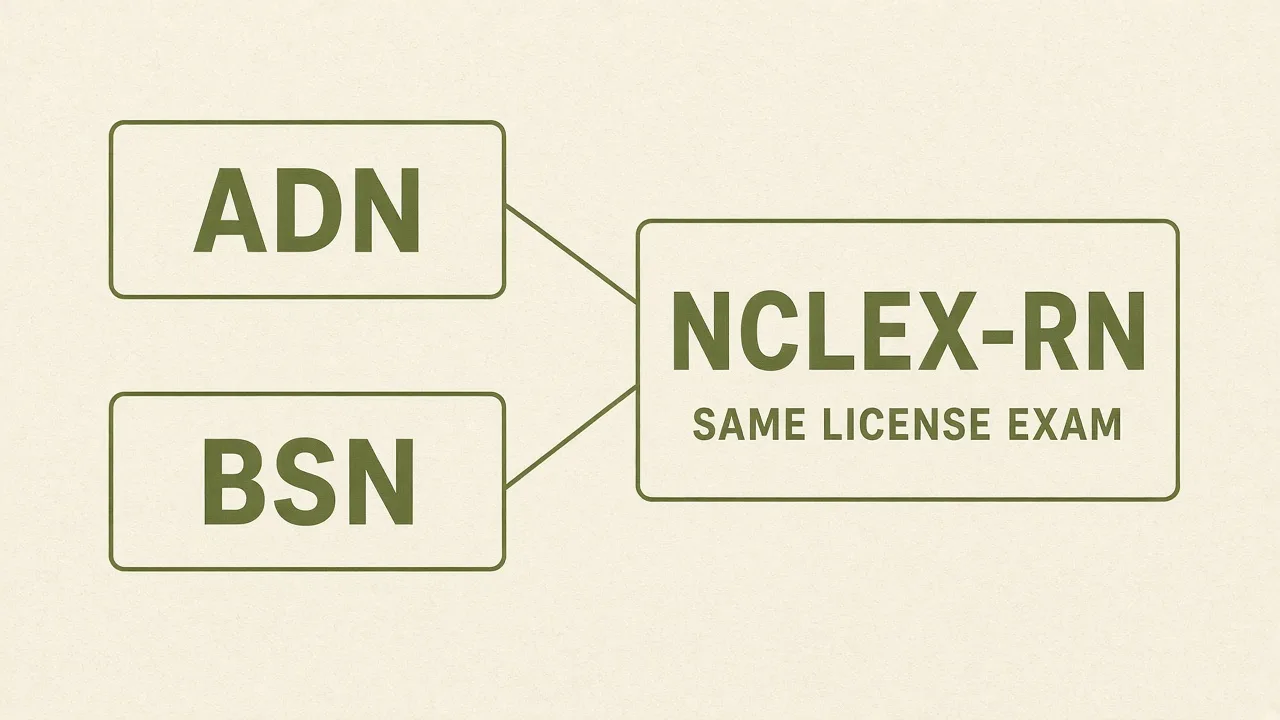
This is the fact that arguments on the internet keep trying to unwrite. ADN graduates and BSN graduates who are made eligible sit the same RN exam. The candidate bulletin does not print a friendlier adaptive test for the community-college graduate. It does not print a harder one for the university graduate. Confirm fees on NCLEX fees and payment. We already walked that money in NCLEX cost in 2026 and the 2027 increase. Nursier does not collect the fee.
Study judgment when faculty put the cohort in that window. Studying NCLEX in the first month of fundamentals is how people fail the course exam in front of them. When you are close, open NCLEX-RN. Do not open NCLEX-PN because a classmate is an LPN. Those seats are not interchangeable.
The BSN later, and one state that clocks it
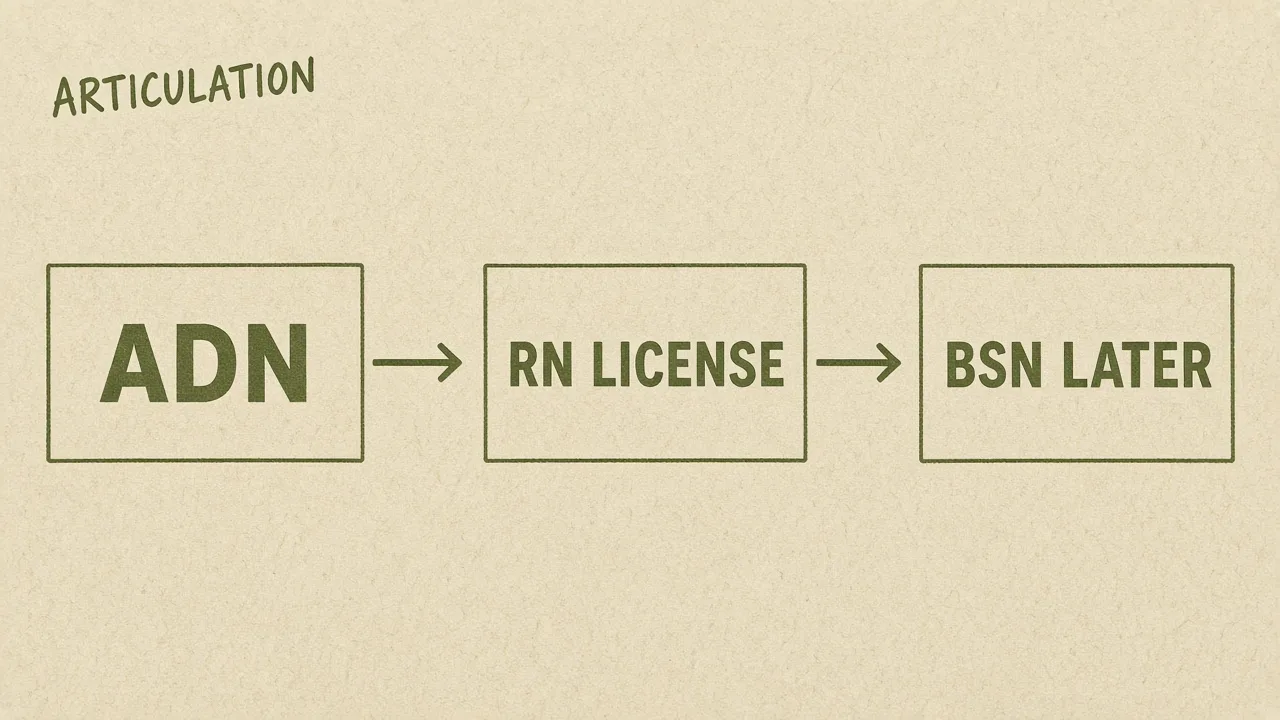
Plenty of hospitals still hire ADN graduates. Plenty of those same hospitals later want a BSN on a timeline. AACN keeps a public sheet on articulation agreements: statewide deals that move ADN credit into RN-to-BSN programs so you do not retake the entire associate curriculum. AACN has counted dozens of states with broad agreements, and a smaller set that mandate credit transfer at public institutions. Your state may be quieter. Ask the community college for the named university list before you pick electives in year zero.
New York is the state that put a clock on the wall. The Office of the Professions explains New York’s BSN in 10 law: many RNs licensed after the law’s start must earn a baccalaureate or higher degree in nursing within ten years of that New York RN license to keep registration. There are exemptions. There is a first deadline window at renewal on or after June 18, 2030 for the first affected cohort. If you will practice in New York, read the Office of the Professions, not a Facebook summary. If you will practice in Ohio, New York’s clock is not yours. It is a method: find whether your state or your employer printed a deadline.
A BSN later is a credential purchase. It is not “becoming a nurse” a second time. If that degree is online, the week still has proctors and deadlines. The logistics article is for that week. The accreditation article is for the stamps.
Money without a fake national tuition
We will not invent a “typical ADN costs X” figure. Community-college tuition and university tuition are different animals, and residency rules change the animal again. Use tools that already exist.
- College Scorecard for the institution’s average annual cost and borrowing, with the usual limits of school-level data.
- The college’s net-price calculator, with your real household numbers.
- The board’s fee schedule, a fingerprint vendor, and Pearson’s registration, which is not tuition.
- The quiet costs: a second background check, parking at the county hospital, a lost night shift, a TEAS retake if the college will even count it.
Federal aid follows eligible programs at eligible schools. A pretty payment plan is not the same as a Title IV program. If you need loans, confirm the ADN is aid-eligible before you schedule the entrance exam.
BLS published a 2025 median RN wage that includes twenty-year veterans and high-cost cities. It is not an ADN signing bonus. Read the BLS pay tab for the percentile story, not for a promise.
Evening and weekend cohorts
Some community colleges run a day cohort and an evening or weekend cohort for people who already hold a job. The content is supposed to be the same. The sleep is not. A 5:30 p.m. lecture after a 6 a.m. clinical is a design you must survive, not a personality test you fail.
Ask whether the evening cohort still has 6:30 a.m. clinicals. Many do. Evening means lecture. It does not mean the hospital moved its report time. Ask whether refusing the evening offer dumps you from the year, the way CT State describes a refused campus offer. Get that in email.
After you get the seat
Write the campus, the cohort, and the entrance exam you already sat. Then stop collecting worksheets from other colleges. Collecting worksheets feels like progress. It is not a lab hour.
If the next task is still a TEAS or HESI date, sit that exam. If the next task is A&P, finish the lab. If the next task is a license exam, study that exam. Sit practice questions when you are ready to do work that is not shopping. Unofficial RN practice belongs with an RN track. Keep PN products apart. The Nursier editorial team wrote this.
We do not take program deposits. We do not take board fees. We do not take NCLEX fees. Your college, your board, and Pearson keep those payments.
Common questions
Is an ADN a real RN?
If the program is board-approved and you pass NCLEX-RN and the board prints the license, you are an RN. The degree is associate. The license is RN. Employers may later want a BSN. That is a job market, not a secret second exam.
Is a BSN more of a nurse on test day?
The license exam is the same. The degree is different. Some units pay for the BSN later. Some want it on a deadline. New York put a ten-year clock on many new RNs. Your state may not.
Should I wait three years for a BSN seat instead?
Only if you can afford the wait and the university calendar. An ADN that starts next fall, plus a named RN-to-BSN articulation, is how a lot of working adults actually get the license. A BSN you cannot enter is not a moral high ground. It is an empty year.
I am an LPN. Is the ADN a bridge?
Some colleges run LPN-to-ADN advanced placement. CT State’s packet, for example, describes LPN advanced placement into the first semester with a later option. Your campus PDF wins. Keep PN exams and RN exams apart. If ATI LPN or HESI LPN is the test in front of you now, study that one.
Do I need TEAS if I already have a degree?
If the ADN packet names TEAS, you need TEAS, degree or not. A bachelor’s in psychology does not retire a community-college entrance exam. Read the line.
Can I work full time through an ADN?
Some people do, on evenings, and they look tired in clinical. Ask the program for the median finish time among students who work 32 hours or more. If they cannot say, believe the silence.
Sources
Confirm live pages. Rating sheets move.
- BLS Occupational Outlook, registered nurses
- AACN, impact of education on nursing practice
- AACN, ADN programs and articulation
- AACN, articulation agreements
- ANA, ADN vs. BSN
- Craven Community College, ADN rating sheet (PDF)
- CT State Community College, nursing information packet (PDF)
- Santa Barbara City College, ADN application requirements
- New York Office of the Professions, BSN in 10
- New York Education Law § 6905
- NCSBN, national simulation guidelines
- NCLEX fees and payment
- College Scorecard
Nursier is independent. We are not affiliated with, endorsed by, or sponsored by NCSBN, Pearson VUE, ATI, Elsevier, AACN, ANA, BLS, Craven Community College, CT State Community College, Santa Barbara City College, or the New York State Education Department. This article is planning copy. It is not an application, and it is not legal advice. Rating formulas belong to the colleges that publish them.