How to get into workers’-comp nurse triage without confusing the jobs
Workers’-comp nurse triage is a telephone or portal job: a licensed nurse listens to an injured worker, sorts urgency, and routes care under a state workers’ compensation system. It is not the adjuster. It is not a full-duty note. It is not a Facebook hourly rate. A 6:40 a.m. Spokane headset on a warehouse sprain from another state is three jobs at once if you let it be. The recording will keep the one you actually do.
This guide names the seats, what the nurse does not decide, and how CMSA and a state bureau write the role. Compensability is not a nursing act. Keep remote work on the member has a state. Keep desk exits on the posting is the filter. Keep the compact on home state and the 60-day rule.
How workers’-comp nurse triage actually works
Workers’ compensation is a state system with a federal office for some employees. The Department of Labor’s Office of Workers’ Compensation Programs is the public door for federal civilian employees, some energy workers, and other named programs. It is not your state warehouse sprain. Read DOL OWCP only if the worker actually sits in that system. Everyone else starts with the state workers’ compensation board or industrial commission.
CMSA’s standards list workers’ compensation companies as a case-management setting. They also say the state bureau defines qualifications and job requirements. That sentence is the whole article. A national “nurse triage script” cannot override a bureau circular. Read CMSA’s standards page.
Who sits on the call
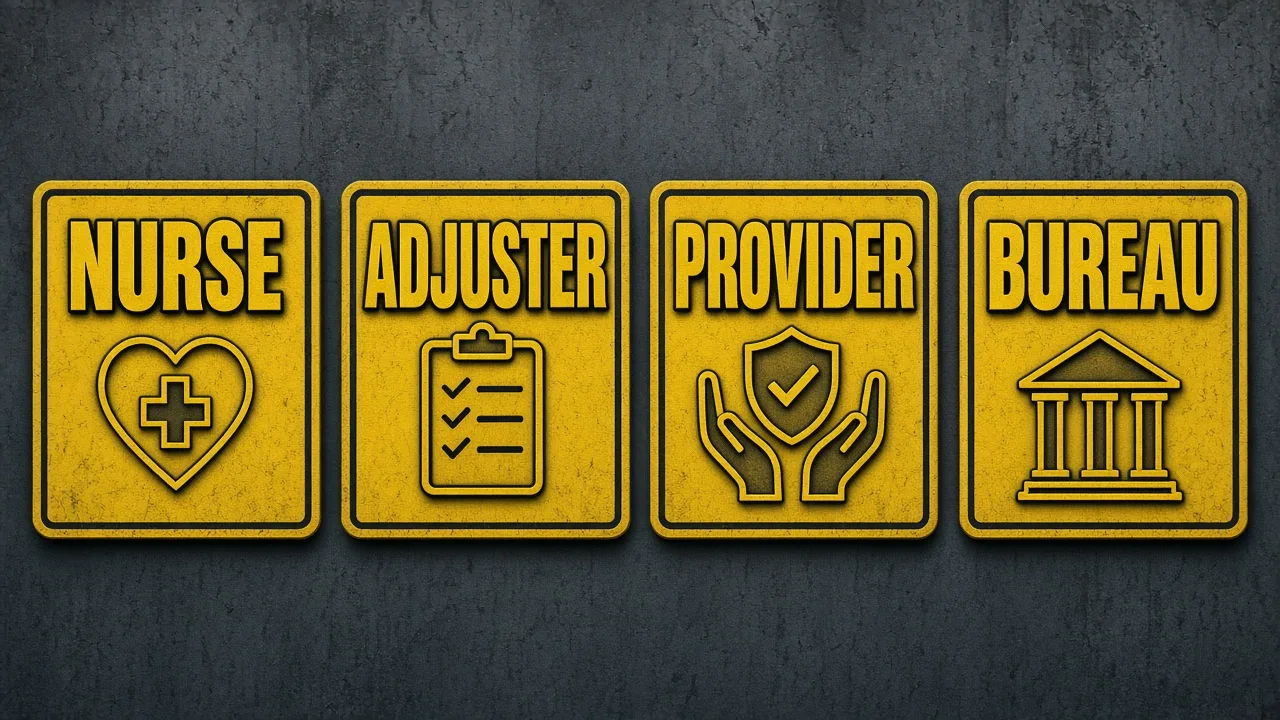
| Seat | What the public sources usually mean | What they do not mean |
|---|---|---|
| Injury-intake or telephonic triage nurse | Symptom questions, first-aid direction, a referral to occupational medicine or the ER | A promise that the claim will pay |
| Nurse case manager | Liaison among worker, employer, and treating provider; appointments; return-to-work facts | Directing treatment or writing the benefit check |
| Utilization review nurse | Medical-necessity review against a guideline the payer named | The same job as bedside advocacy in a hallway |
| Claims adjuster | Compensability, indemnity, and the file | A nursing license |
Indiana’s Worker’s Compensation Board published a plain version of the case-manager lane: communicate, schedule, explain terms, help the stay-at-work plan. It is not the role of that nurse to determine compensability, administer benefits, deliver or direct treatment, or give a medical opinion that replaces the treating provider. Read Indiana’s nurse case manager guidelines as a teaching example, not as your state’s law. Your bureau may be stricter. Your bureau may be quieter. Open that page.
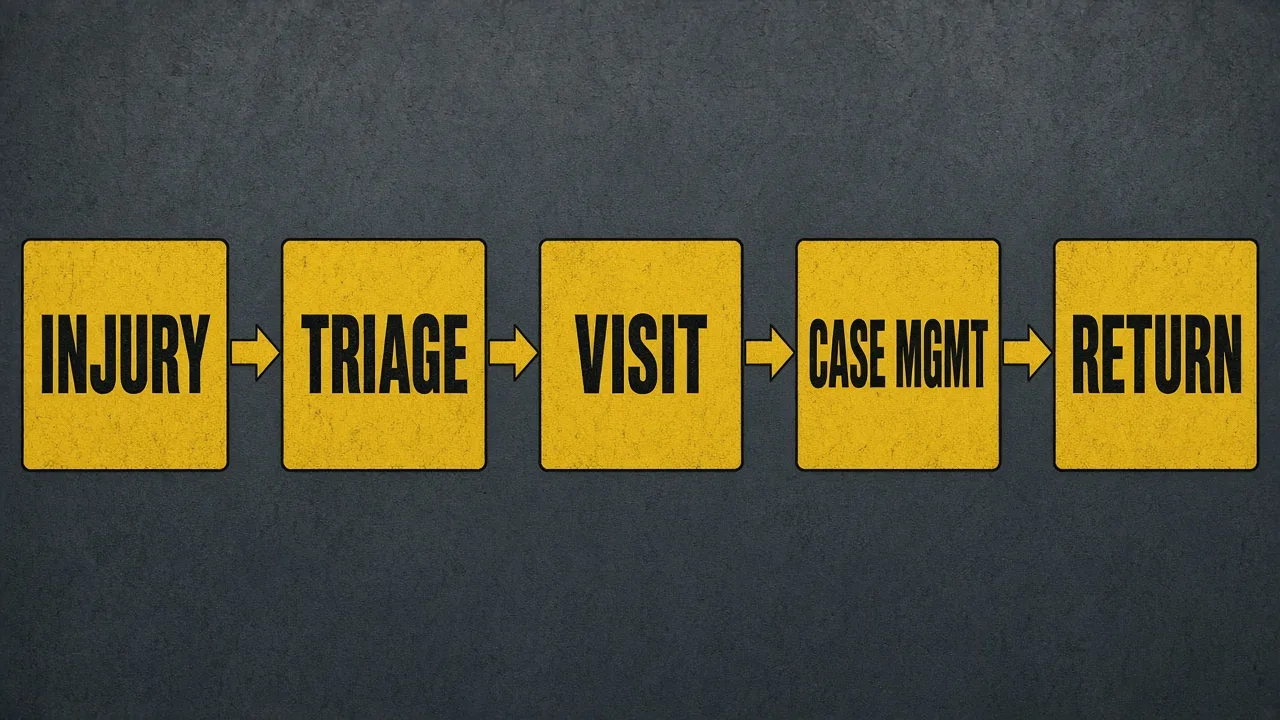
What the nurse does not decide
- Whether the injury arose out of employment.
- Whether the person gets wage replacement this Friday.
- Whether surgery is “the claim’s” idea. The treating provider writes the plan. Review may sit next to that plan. Review is not the incision.
- Whether the worker should fire the attorney. That is not a nursing act.
You can document what you asked, what the person said, where you sent them, and which protocol your employer named. You can tell a person how to ask the adjuster a question. You cannot become the adjuster because the headset is on.
Triage, case management, and utilization review
Job ads mash these words. CMSA’s later writing is useful because it separates them. A case manager may do utilization-management tasks, or may sit next to that team. Utilization management includes prior authorization, medical-necessity review, and concurrent or retrospective review. Case management, in the workers’-comp setting, is still coordination and return-to-work. If the posting wants denials coded by the hour, that is a UR product. If it wants a liaison who knows the workstation, that is a case-manager product. Read the posting twice. The compact and your board still apply if the work is nursing. A headset does not erase the license.
The claim has a jurisdiction
The sprain in another state is not “remote, so national.” The claim file belongs to a statute. Official medical-fee schedules, panel-physician rules, and nurse-case-manager circulars are local. Your RN license belongs to a board. Those two maps can disagree. That is the same family of problem as a remote member who lives in a non-compact state. Do not reprint a sixty-day rule here. Open the compact article if the license is the question. Open the bureau if the claim is the question.
What not to promise this month
Do not tell an injured person the claim will pay. Do not hide notes from the worker if your bureau says the worker can see them. Do not invent a national salary for “WC triage.” If you still need unofficial license-exam practice, sit practice questions for the exam in front of you. The Nursier editorial team wrote this. We do not take an adjusting fee. Those carriers keep those payments.
After you name the role
Write four facts: the posting title, the bureau that owns the claim, whether the work is triage, CM, or UR, and which board holds your license. Then close the ad that said “just nurse triage.” A headset is not a statute.
Common questions
Is workers’-comp triage the same as ED triage?
No. Emergency triage is a hospital act under that facility’s policy. Comp intake is a claim-adjacent act under a payer or employer protocol. Do not mix the ESI scale into a warehouse sprain unless that protocol named it.
Do I need a case-manager credential?
Some bureaus and some employers do. Indiana’s example names CMSA standards and recognized credentials. Your circular wins. Do not invent a national must.
Can I do this job from another state?
The claim has a state. You have a license. Both maps have to work. Read the posting and the bureau. Remote is not a waiver.
Is this legal advice?
No. This is planning copy so you can read a posting. A claim question belongs to the bureau, the adjuster, or a lawyer the worker chose.
Sources
- U.S. Department of Labor, Office of Workers’ Compensation Programs
- CMSA, standards of case management practice
- Indiana Worker’s Compensation Board, nurse case manager guidelines
Nursier is independent. We are not affiliated with DOL, CMSA, or any state bureau. This article is planning copy. It is not legal advice, not a claim decision, and not a denial.