VEAL CHOP and the three NICHD categories, together
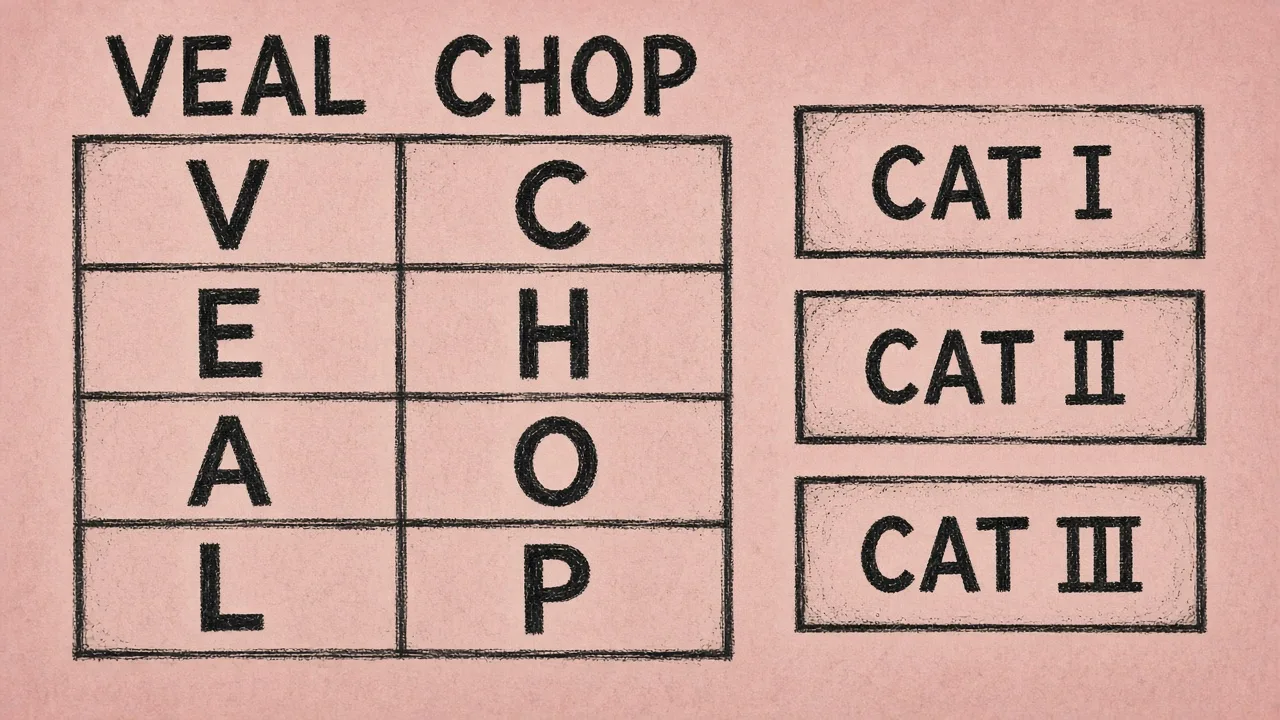
VEAL CHOP is a classroom hook for fetal-heart-rate shapes: Variable with Cord, Early with Head, Acceleration as OK, Late with placental insufficiency as a teaching word. It helps a Birmingham student name why a shape appeared. It does not name Category I, II, or III, and it does not name baseline or variability. The charge nurse still wants those. The 2008 NICHD three-tier system is the language the rest of the room uses.
This guide teaches both: the mnemonic so you can find the shape, then the categories so you can talk to the provider. It will not manage a birth. Keep RAAS on renin to aldosterone. Keep NCLEX on nine ways that match the test plan.
How to use VEAL CHOP without replacing the category
Electronic fetal monitoring is the common obstetric procedure in U.S. labor rooms. The public spine is still the 2008 NICHD workshop report, which ACOG, NICHD, and the Society for Maternal-Fetal Medicine put their names on. ACOG later replaced older practice bulletins with a 2025 clinical practice guideline on intrapartum fetal heart-rate monitoring. Those documents are the protocol family. A mnemonic from a fundamentals lecture is not. Read a public summary of the three-tier system in NCBI’s fetal heart-rate classification appendix and ACOG’s 2025 guideline page. We will not invent a hospital algorithm.
What VEAL CHOP actually maps
Students use two columns. The left column is the shape. The right column is a cause people associate with that shape. It is a memory hook. It is not a diagnosis of the placenta.
| Shape (VEAL) | Hook (CHOP) | What you still owe the strip |
|---|---|---|
| Variable deceleration | Cord compression | Onset, depth, duration, and whether it is recurrent |
| Early deceleration | Head compression | Mirrors the contraction. Still name variability |
| Acceleration | OK, or oxygenation as a classroom word | Present or absent. Category I allows either |
| Late deceleration | Placental insufficiency as a classroom word | Starts after the peak. Recurrent lates change the room |
If the hook helps you find the shape, keep it. If the hook replaces the category, throw it out for the rest of the shift. “Late equals placenta” is how people skip baseline and variability and then cannot talk to the provider.
The three categories the workshop named
NICHD’s three-tier system is the language that survives a change of shift:
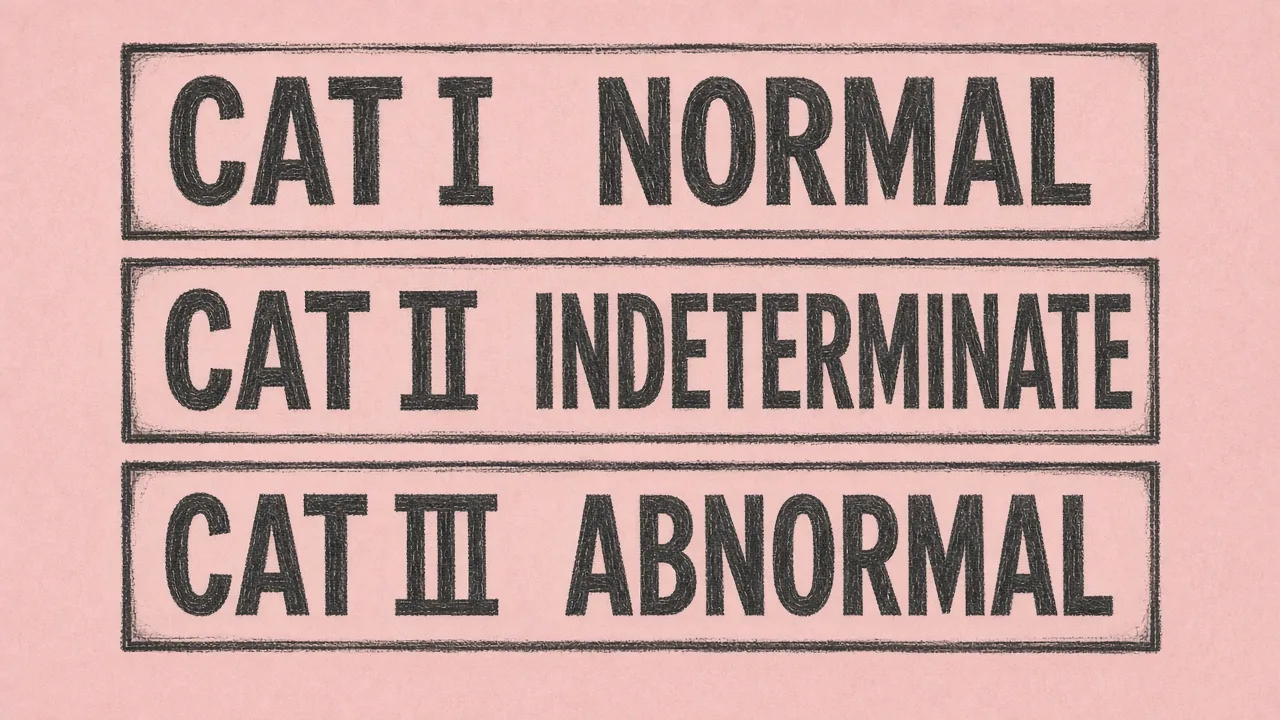
- Category I, normal. Baseline 110–160. Moderate variability. No late or variable decelerations. Early decelerations may be present or absent. Accelerations may be present or absent. Strongly predictive of normal acid-base status at that moment. Can be followed in a routine manner.
- Category II, indeterminate. Everything that is not I or III. Not predictive of abnormal acid-base status. Needs evaluation, continued surveillance, and reevaluation in the whole clinical picture. A large share of real strips live here. The mnemonic does not have a box for that fact.
- Category III, abnormal. Absent variability plus recurrent lates, recurrent variables, or bradycardia; or a sinusoidal pattern. Predictive of abnormal acid-base status at that moment. Needs prompt evaluation. The workshop listed possible intrauterine-resuscitation steps as examples, not as your hospital’s order set: position change, stopping labor stimulation, treating hypotension, and similar measures the team already owns.
A tracing can move. Categorization is this window of time. It does not predict cerebral palsy. It does not replace the rest of the labor.
Words the strip still needs
- Baseline, in beats per minute, over a 10-minute window that is not a deceleration.
- Variability: absent, minimal, moderate, or marked.
- Accelerations that meet the definition for that gestational age.
- Decelerations: early, late, variable, prolonged. Recurrent or intermittent.
- Uterine activity. Tachysystole is a contraction word. It is not a fetal category by itself.
If you cannot say those words, VEAL CHOP is a costume. Sit maternity items from the exam in front of you, not a rhyme contest.
What not to do with a rhyme
Do not tell a laboring person the baby is “fine” because you remembered CHOP. Do not hide a Category III behind a mnemonic. Do not invent oxygen liters because a video said so. Official management sits with the obstetric team and the current ACOG guideline. If you need unofficial practice, sit practice questions. The Nursier editorial team wrote this.
After you can name the category
Write four facts on the next strip: baseline, variability, decelerations, category. Then say VEAL CHOP only if it still helps you find the shape. We do not take a delivery fee. Those units keep those payments.
Common questions
Is VEAL CHOP wrong?
It is incomplete. As a hook for shapes, teachers still use it. As a substitute for NICHD categories, it fails.
Does Category II mean the baby is in trouble?
Category II is indeterminate. It is common. It needs evaluation, not a slogan. The whole labor sits next to the strip.
Can I manage Category III from a blog?
No. Prompt evaluation belongs to the team in the room. A mnemonic is not an order set.
Is this the same as the neonatal NP exam?
No. This is an intrapartum strip. The neonatal NP door is a later license and an NCC exam. Different patient. Different page.
Sources
- NCBI Bookshelf, fetal heart-rate classifications
- ACOG, intrapartum fetal heart-rate monitoring, 2025
Nursier is independent. We are not affiliated with NICHD, ACOG, or AWHONN. This article is planning copy for students. It is not a protocol, not a delivery, and not a category assignment for a real labor.